Design as an attitude
The Musée des Arts décoratifs et du Design de Bordeaux presents a nuanced exploration of a designer whose work is characterized by clarity, consistency, and a keen understanding of industrial conditions. In just over a decade, Pauline Deltour produced around 180 designs that span different scales, typologies, and contexts of use, yet reveal a coherent design philosophy. An early key project is the wire baskets for Alessi: they appear light and effortless, their form resulting from a precise examination of material and construction. This approach continues in later projects. Deltour designs movable stools for COR, develops the “Étreintes” ring with interlocking lines, and works on an electric bicycle for La Poste. This range shows no stylistic breaks, but rather a continuous engagement with structure, function, and production.
The exhibition focuses on the design process. Drawings, models, and photographic documentation from the archives of the Pauline Deltour Design Office make this process comprehensible. They reveal a working method that proceeds analytically and is closely oriented toward the conditions of production. The influence of her time in Konstantin Grcic’s studio is clearly evident. At the same time, it becomes apparent how Deltour translates this experience into her own practice, using technical constraints as a starting point.
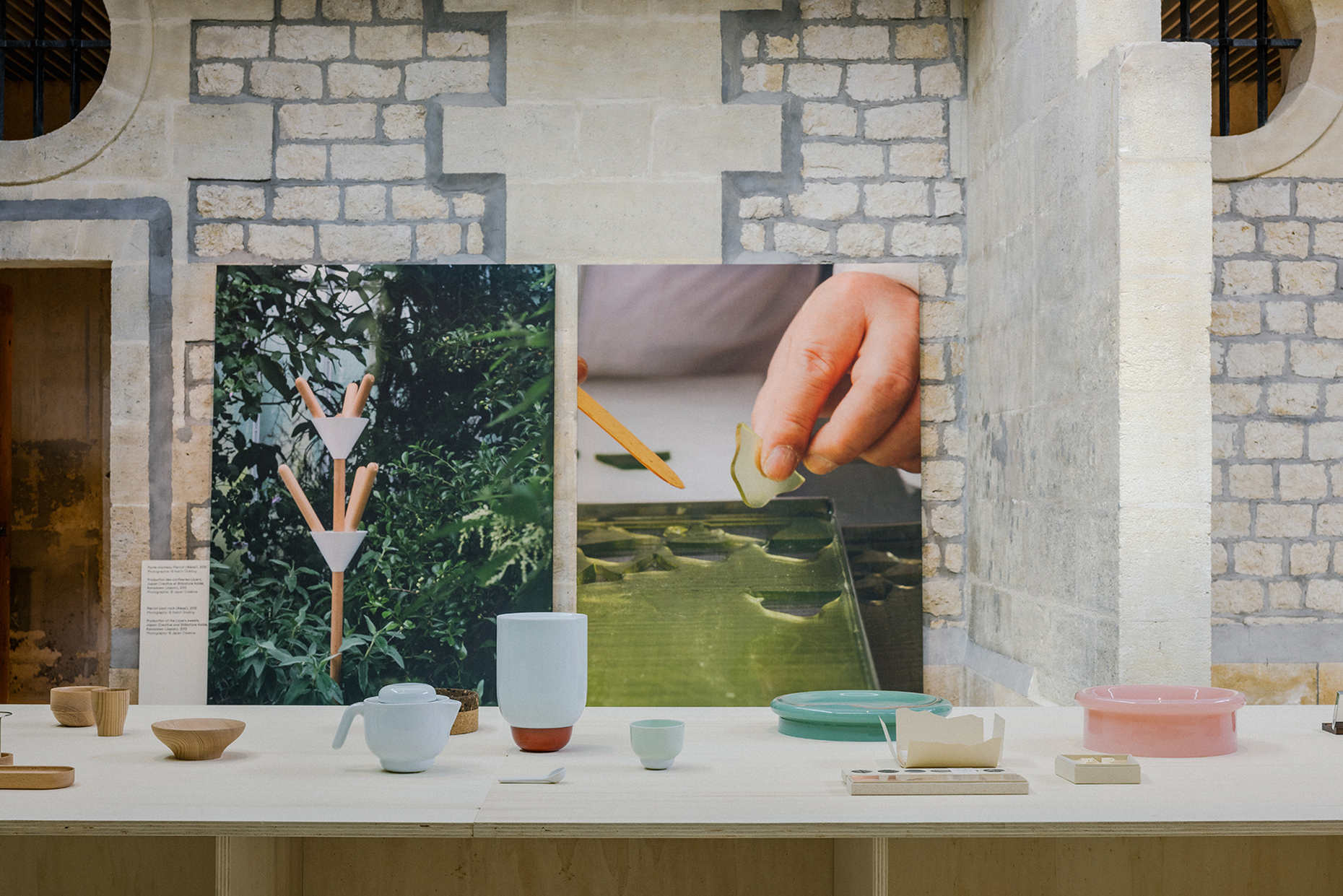
Deltour focused on the manufacturing process. She examined materials, tools, and processes with great attention to detail. This resulted in a balance between function and lightness that is characteristic of many of her works. This approach is also evident in her international collaborations – for example, with manufacturers in Japan, Italy, Colombia, and the United States—through which she expanded her exploration of the relationship between production and use. The exhibition also emphasizes the physical experience of design: many objects can be directly engaged with. Proportion, weight, and mobility become comprehensible through direct contact, and their spatial and functional impact is readily apparent.
A particular strength of the exhibition lies in its curatorial structure: the team of Bérengère Bussioz, Konstantin Grcic, Caroline Perret, and Étienne Tornier all shared a personal connection to the designer. This closeness is palpably evident in the exhibition. It eschews a heavily interpretive framework and instead relies on a calm and direct presentation of the works. For viewers, this creates a form of engagement that argues from a practical perspective and places the logic of the designs at the center. The scenography by Caroline Perret and Konstantin Grcic follows this approach. The space remains clearly structured, and the objects are arranged in an accessible and comprehensible manner. There are no overly staged effects. This decision directs attention toward construction methods, materiality, and scale. The participation of Claire Pondard from the Design Office reinforces this direct connection to the designer’s working reality.
"Pauline Deltour, une apparente simplicité" is overshadowed by an early tragedy: Pauline Deltour passed away unexpectedly on September 10, 2021, causing great consternation in the international design scene. Against this backdrop, the retrospective appears also as a poignant engagement with a body of work that has had a remarkable impact in a brief period of time.
Pauline Deltour, une apparente simplicité
Through September 21, 2026
MADD – Musée des Arts décoratifs et du Design de Bordeaux
39 rue Bouffard
33000 Bordeaux
The retrospective is accompanied by a monographic publication.