REVIEW – SALONE DEL MOBILE & MILAN DESIGN WEEK 2026
The Great Desire
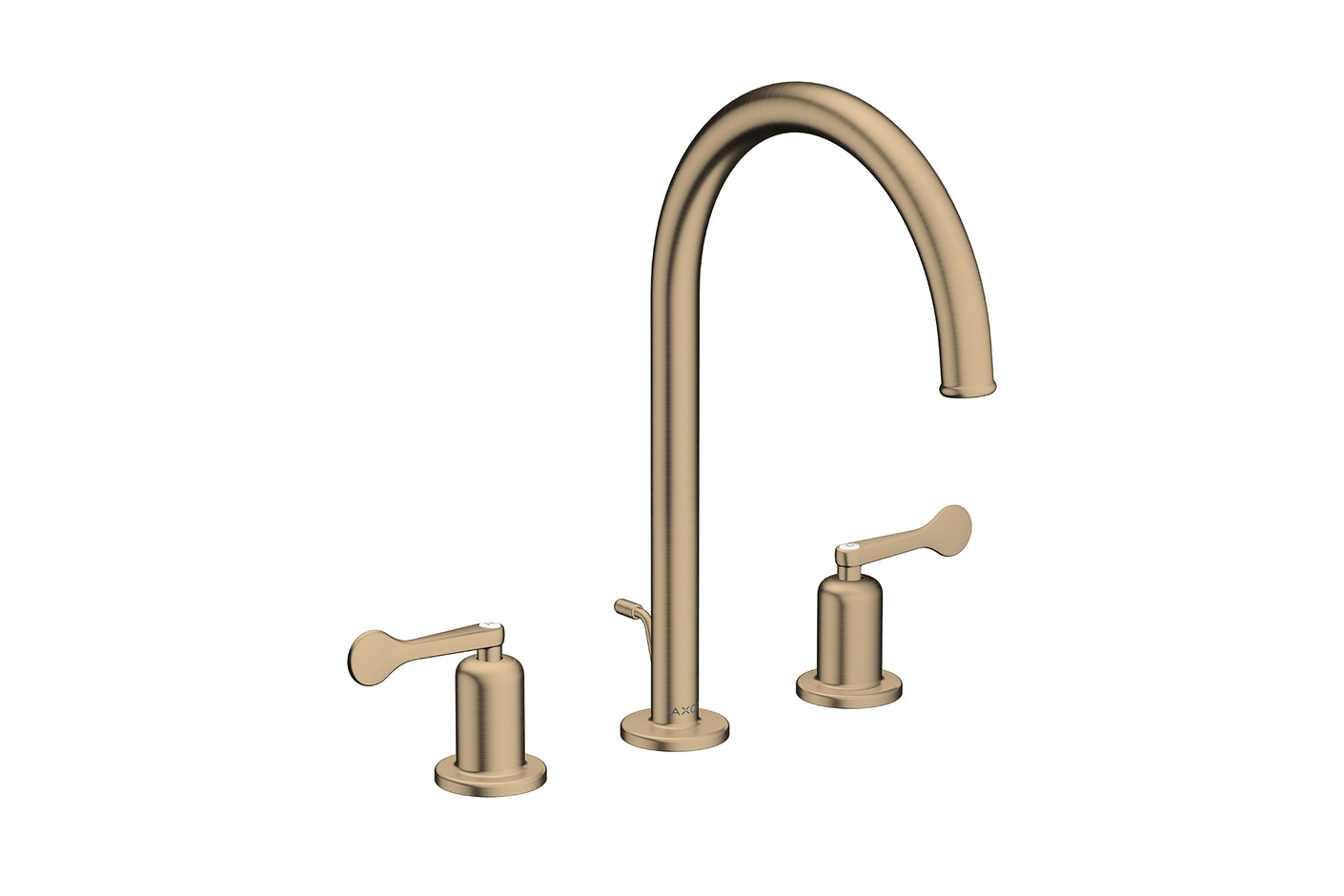
‘We don’t live in a single, defined style. Not modernism, not minimalism, not postmodernism. We live in the age of the archive.’ The quote comes from an interview I recently conducted with the designer Jay Osgerby. The subject was the new ‘Archivio’ tap, which he designed for AXOR in collaboration with Edward Barber. A familiar form, gently adapted to the present and manufactured using the latest technology. “We live in the age of the archive” – this phrase often came to mind as I made my way through the halls of the Salone del Mobile and the showrooms around the city. Whilst the retro frenzy of recent years has now died down somewhat, the reference to existing design remains clearly visible. Since the pandemic six years ago, there has been a need to value what we already have, a trend the industry reliably reflects in its ranges: rather than focusing on new collaborations with young creatives, the archetypal furniture designs of recent decades are being dusted off and gently reworked – out of nostalgia in times of crisis, out of a lack of resources, out of concern over uncertain investments. People value what they know. A search for the essential, the authentic, the honest. Design whose structure is instantly understood, which needs no artificial filters or AI to convince. Which does not confuse with complexity or hold up unwanted surprises. Craftsmanship and technology in harmony, rather than in competition.
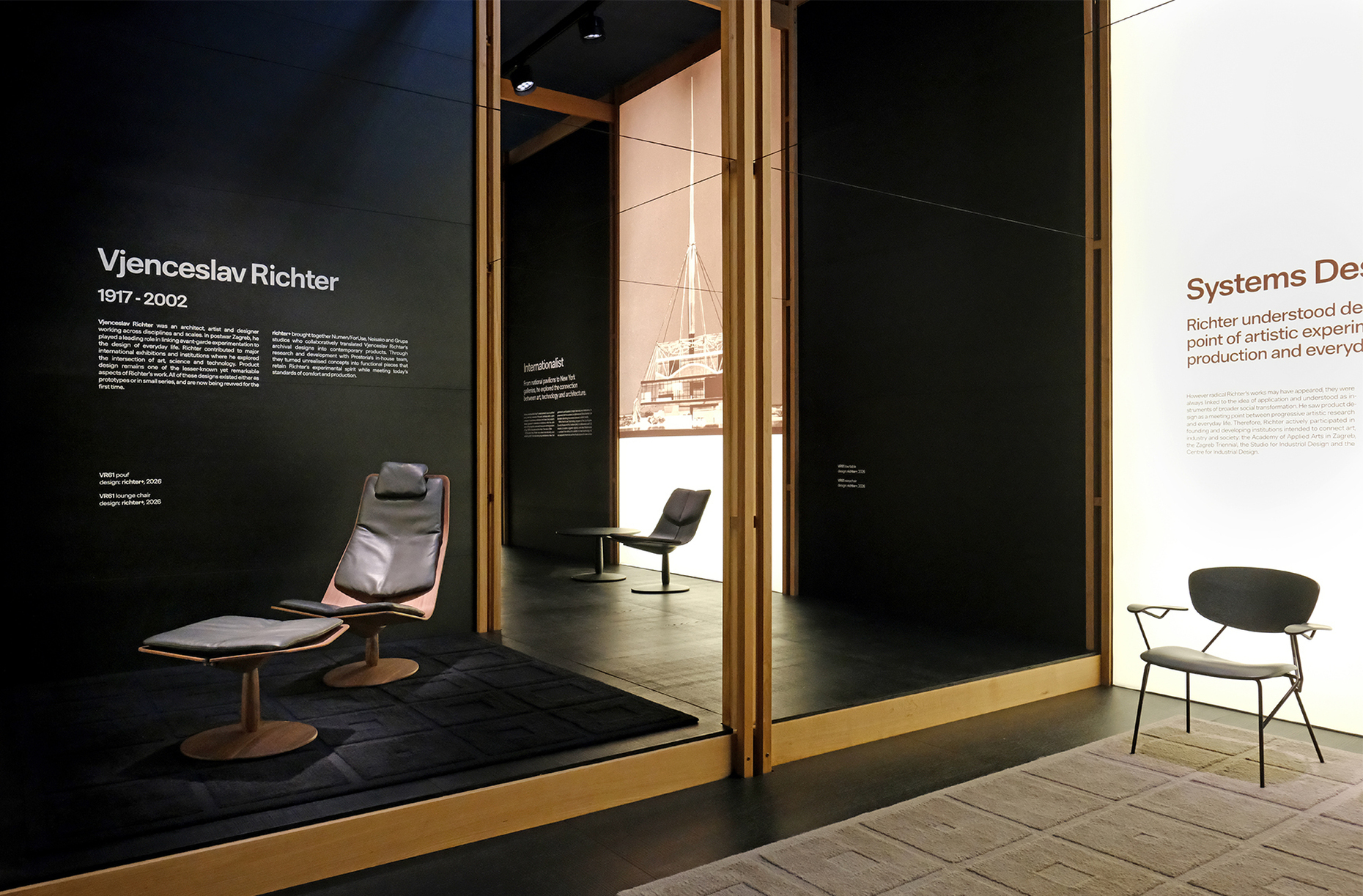
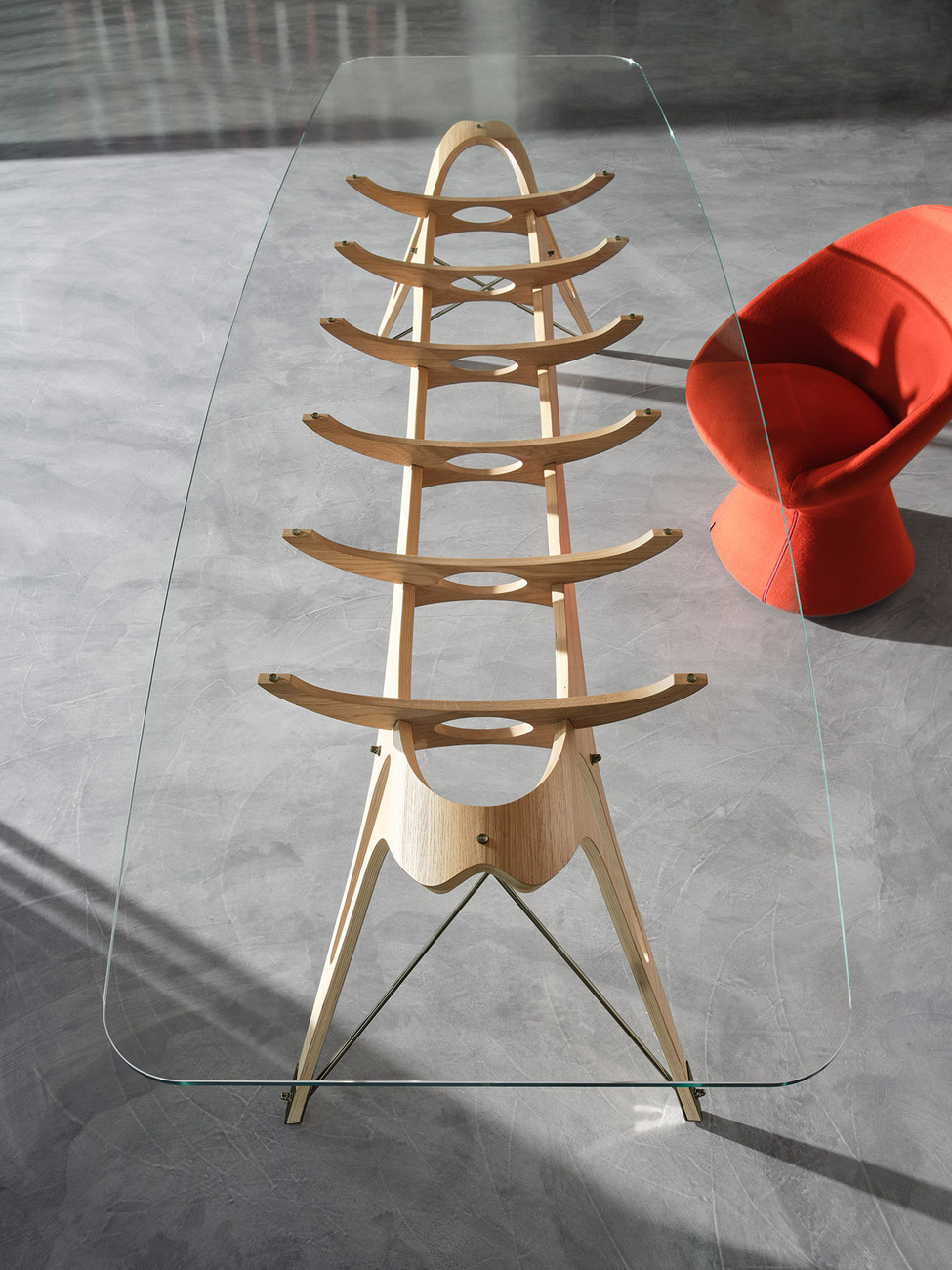
Prostoria thus dedicated its entire presentation at the Salone del Mobile to the work of architect Vjenceslav Richter (1917–2002), whose ideas are being carried forward through research, development and in-house production in five series comprising a total of 20 pieces. Knoll had the “Morrison Hannah Chair” swivel chair, developed by Andrew Morrison and Bruce Hannah in 1973, reimagined for the present day. Under the title “Some Things Deserve a Comeback”, the Stuttgart-based company Richard Lampert included Ernst Moeckl’s “Z.Stuhl” in its collection. In 1971, the graduate of the Ulm School of Design had designed the cantilever chair, which was manufactured from a single block of plastic in both East and West Germany and is considered one of the first of its kind. Zanotta acquired part of the artistic archive of the Italian architect and designer Carlo Mollino (1905–1973) and presented the legendary “Vertebra” table for industrial production for the first time. Its frame struts resemble an aerodynamic fossil, an unmistakable piece of design history. In collaboration with the Bauhaus Dessau Foundation and thyssenkrupp, Tecta has reinterpreted Marcel Breuer’s folding chair from 1926/27 as the “D4 zirkulär”, a limited edition of 100 pieces made from bluemint®Steel. The upholstery consists of upcycled silver linings that once withstood the heat of the blast furnace. Johan Ansander drew inspiration for the “Frankfurter” chair for Bla Station, crafted from beech wood, from historical models of the 1930s – a robust structure with a clear aesthetic for everyday use.
At the International Bathroom Exhibition during the Salone del Mobile, Mamoli reintroduced collections by Joe Colombo and Ettore Sottsass into its lineup. The faithful reproduction of the Joe Colombo collection traces back to the projects “Visiona 1” from 1969 and “Total Furnishing Unit” from 1972, in which the faucet was interpreted as an integral part of both the room and the living space. The fact that, in addition to a reduction to the essentials, an expressive character is once again in demand for faucets was evident in the form of “Samon” by Marco Zito for alpi, which features delicate decorative engravings and an unusual lever handle. Elisa Ossino translated the design language of Italian drinking fountains into a geometric faucet with a distinctive control element for Salvatori and Fantini with “Margherita”.
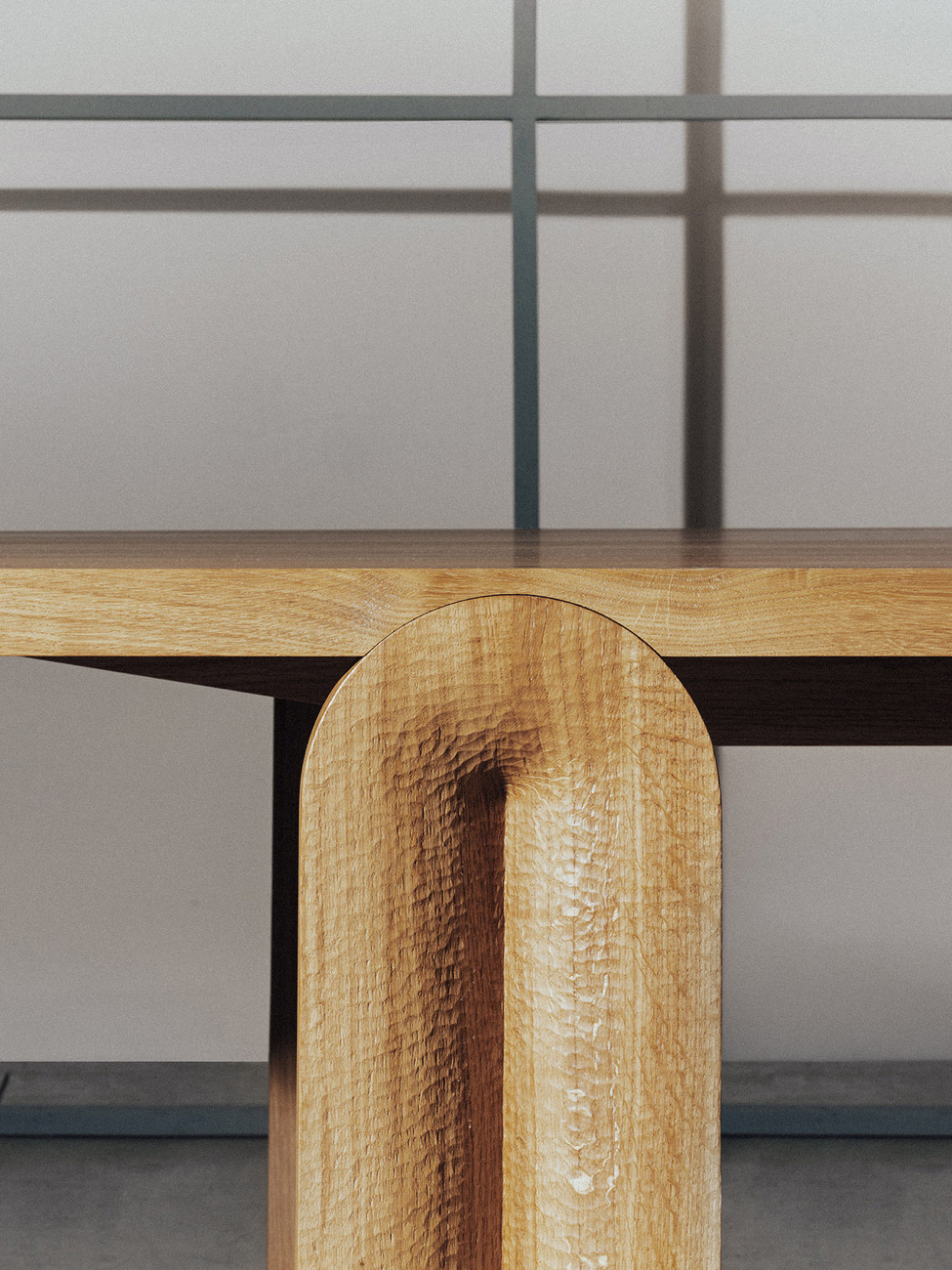
Zanat paid tribute to the craft of woodworking with an exhibition entitled ‘Human Touch: A Decade At Salone’: part of the exhibition was the ‘Nave Table’ by Patrick Norguet, crafted from solid wood, for which he chose a hand-carved texture for the legs. Also exciting was the “Tempo” side table by Palomba Serafini Associati, made from solid wood and inspired by a chess piece. Zanat also unveiled a new retail display system in Milan: a modular framework designed to showcase products perfectly in partner retailers’ showrooms. Arco showcased Ben Capper’s “Enso” product family, crafted from solid wood, for the first time with the “Starburst” inlay pattern, for which the veneer is cut from the heartwood of a tree. Plank impressed with the “Theo” folding chair by Matteo Thun and Benedetto Fasciana, which can be stored ultra-flat. The frame is made of solid oak. At Vincent Sheppard, visitors could discover “Arc” by Axel Enthoven, a dynamic rattan chair design. Decor Walther presented “Onyo”, a collection of accessories in light maple and dark ash that is both durable and practical. In the city, the manufacturer of bathroom fittings and accessories once again exhibited in a sewing shop and, through the staging of a boutique hotel, demonstrated how creatively the team knows how to utilise existing space for a temporary exhibition.
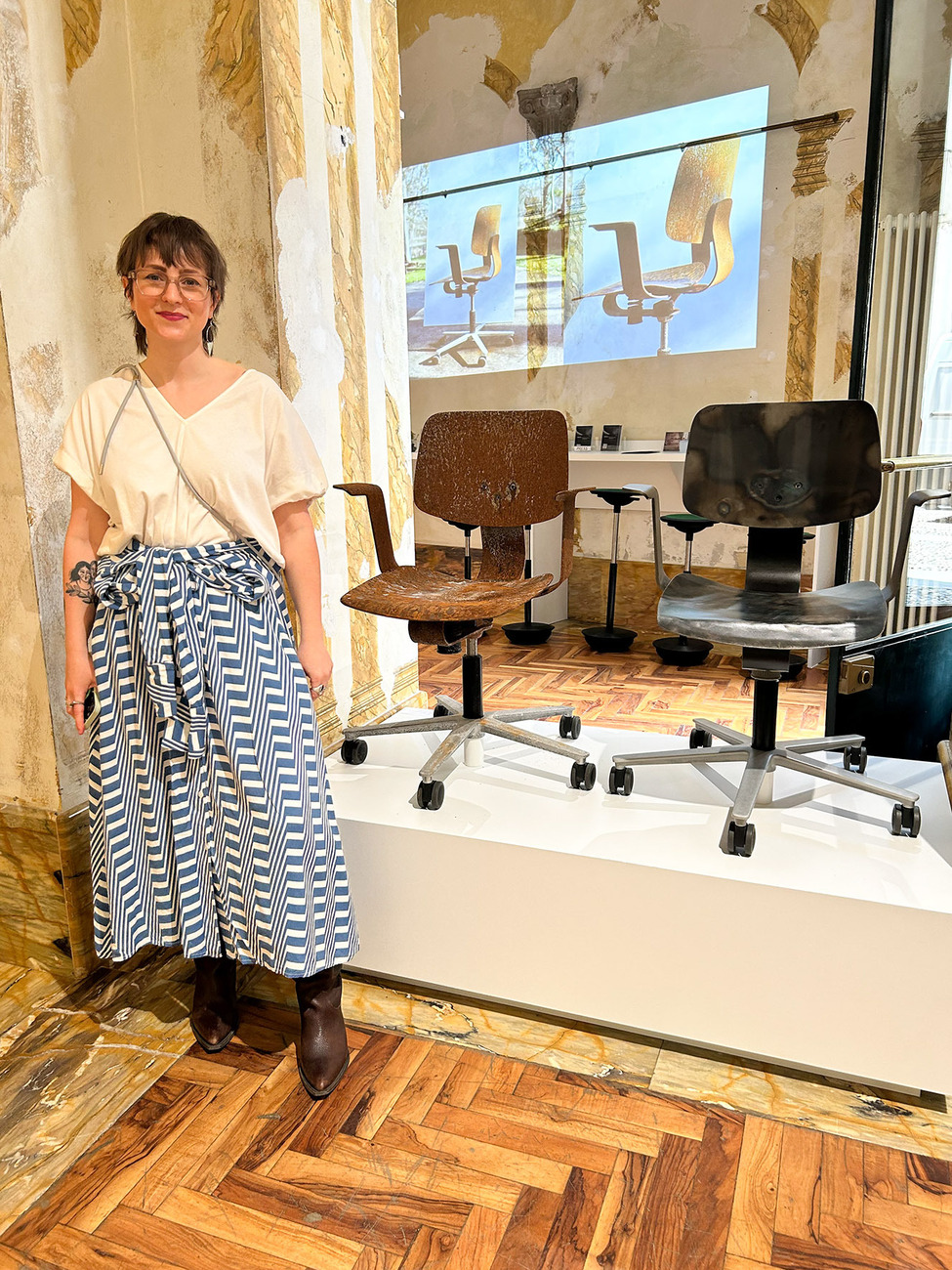
Wilkhahn opened a new perspective on materiality in the context of time, environment and use with the exhibition “What the surface remembers”, curated by Alina Schnizler. Taking the “WiChair” and the material steel as its starting point, this exhibition combined sculptural works and photographic pieces by artists such as Aya Sasakura and Frank Schinski to create a dialogue on permanence and change. Formafantasma created “Estratto” for Pedrali, a collection of coffee tables and side tables made of aluminium. The base consists of three concave profiles which, when joined together, ensure structural stability whilst leaving the interior space empty, creating an elegant interplay of solid and hollow spaces. The concave form modulates and reflects light, enhancing depth and three-dimensionality whilst allowing for simple and functional combinations. Metal and wood were generally two materials increasingly chosen by manufacturers for their new products.
‘Construction zero point’
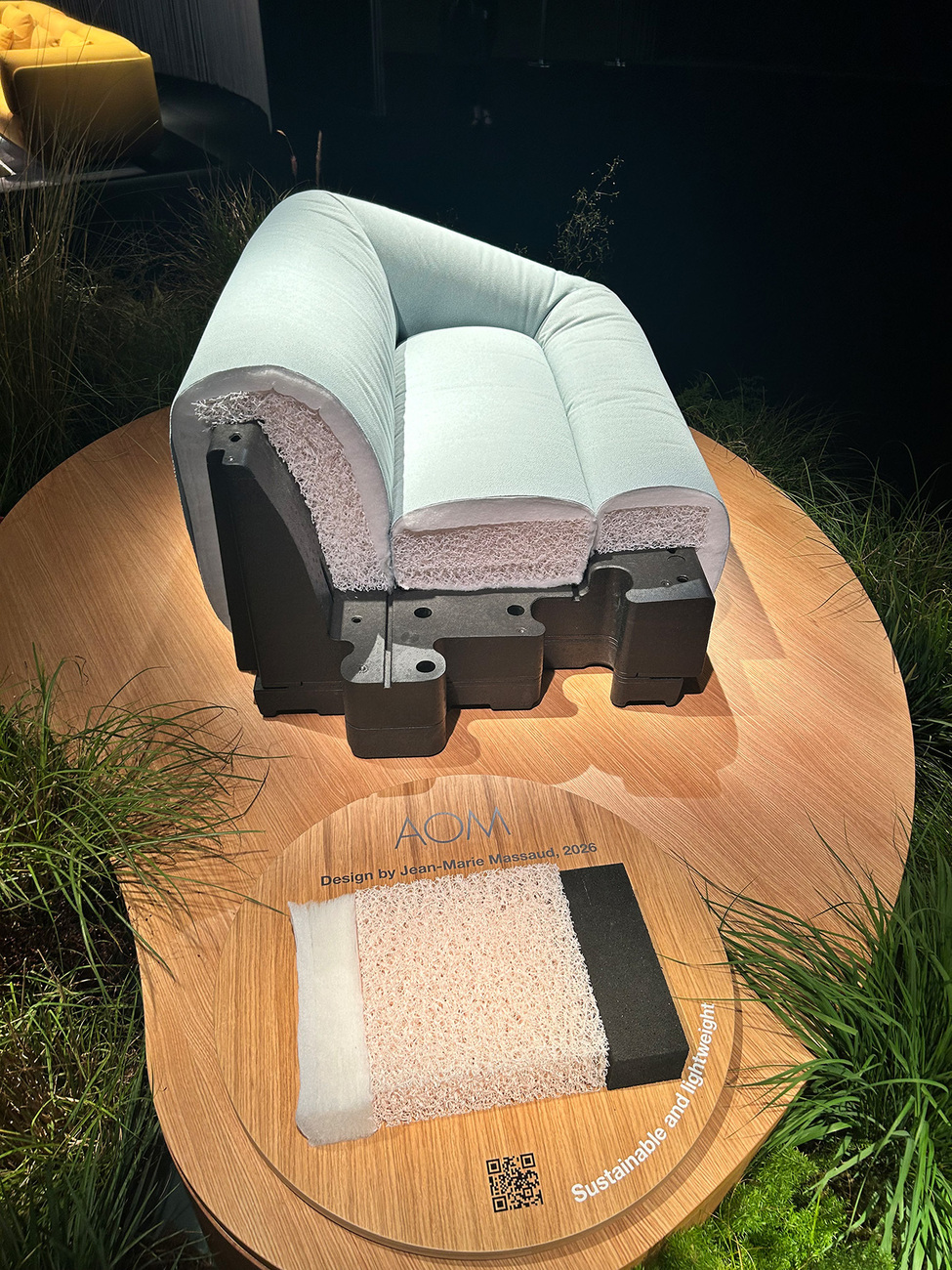
Arper, too, sought to strike a balance between functionality and sustainability. The team found it in Jean-Marie Massaud, who created “Aom”: The entire collection of one-, two- and three-seaters is based on just two components, designed as interlocking elements – a frame made of expanded polypropylene (EPP), which is lightweight and durable, combined with upholstery made of Breathair® and a recyclable polyester elastomer. The material is elastic, breathable and water-resistant, making “Aom” suitable for both indoor and outdoor use. There is no need for polyurethane or adhesives. Stefan Diez was a pioneer in this field with his modular “Costume” sofa for Magis: as early as 2021, he presented a structure made of recycled and recyclable polyethylene complete with a removable fabric cover. For Maxdesign, Diez presented the “Triangolo” collection this year: a chair based on structural simplicity, consisting of two plywood panels, a steel frame and natural upholstery, with the focus on circular design and comfort. The chair is described by the Italian manufacturer as a “constructive zero point”. “With ‘Triangolo’, I am attempting to redefine upholstered seating through simplicity,” says Stefan Diez.
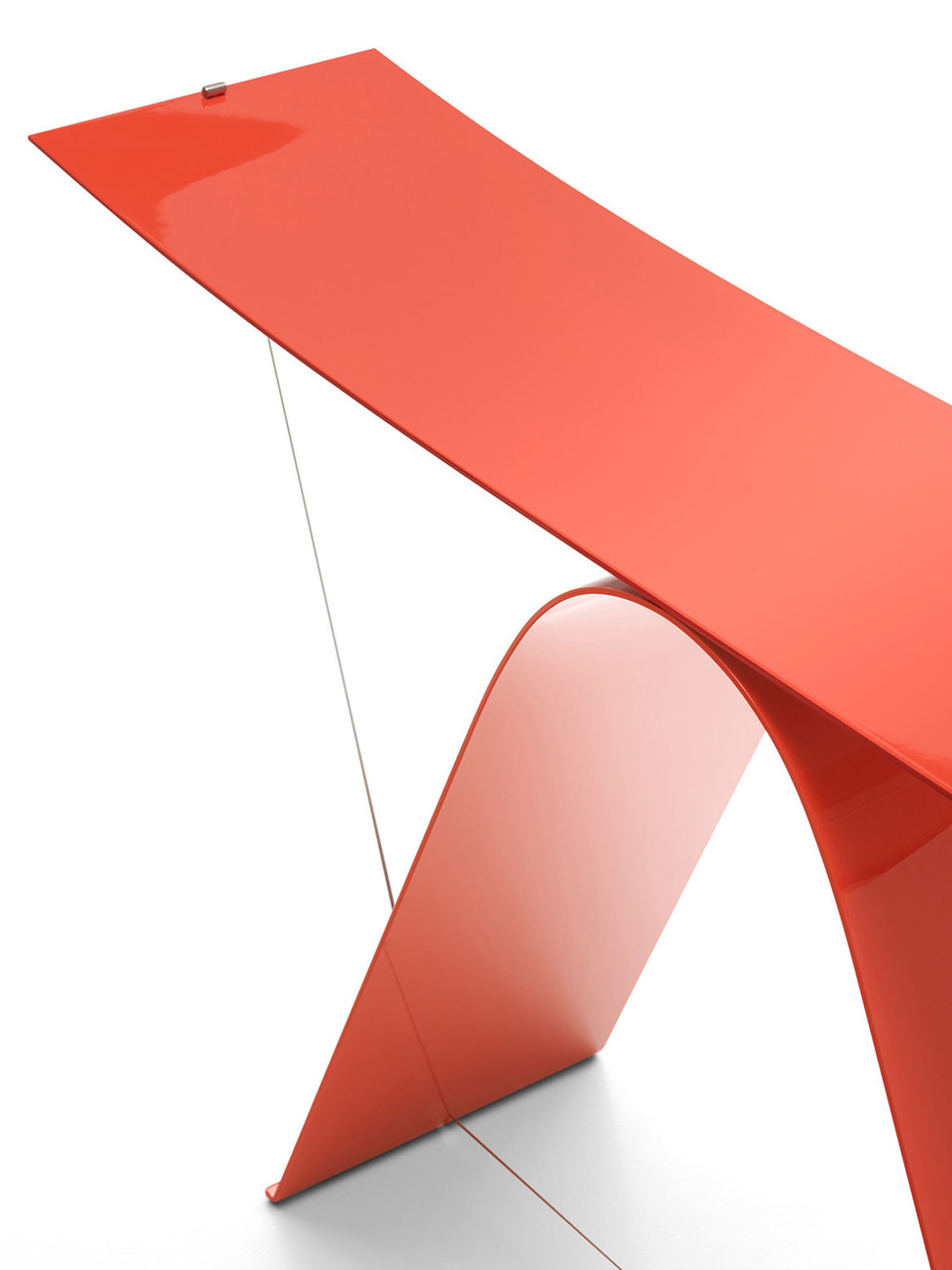
Yabu Pushelberg collaborated with Porro for the first time, designing the ‘Arnaldo’ armchair, which combines comfort and lightness through an interplay of volumes and voids. MDF Italia is delighted to make Guglielmo Poletti’s ‘Equilibrium Console’ – previously produced in a limited edition – available to a wider audience: Its design logic is based on the tensioning of the sheet steel, which contributes to the stability of the structure and creates a subtle curvature. Under the title “Slow Flow”, S•CAB presented an exhibition at the Salone del Mobile created by Calvi Brambilla and Partners, which included the reconstruction of a pond with aquatic plants. Part of the product presentation was “Nolo” by Simone Bonnani, a collection of side tables born from the search for a balance between material and lightness. The concrete top is connected to a steel base that replaces the usual column with two narrow, parallel plates. Atlas Concorde showcased the diversity of its Ceramic Ecosystem, which includes ceramic surfaces, furnishings and accessories: whether it be the stone-effect “Nyra” collection by Alberto Apostoli or the “Tratto collection” by Piero Lissoni, who combines porcelain stoneware with materials such as glass, wood and metal to create furnishings ranging from tables to storage units.
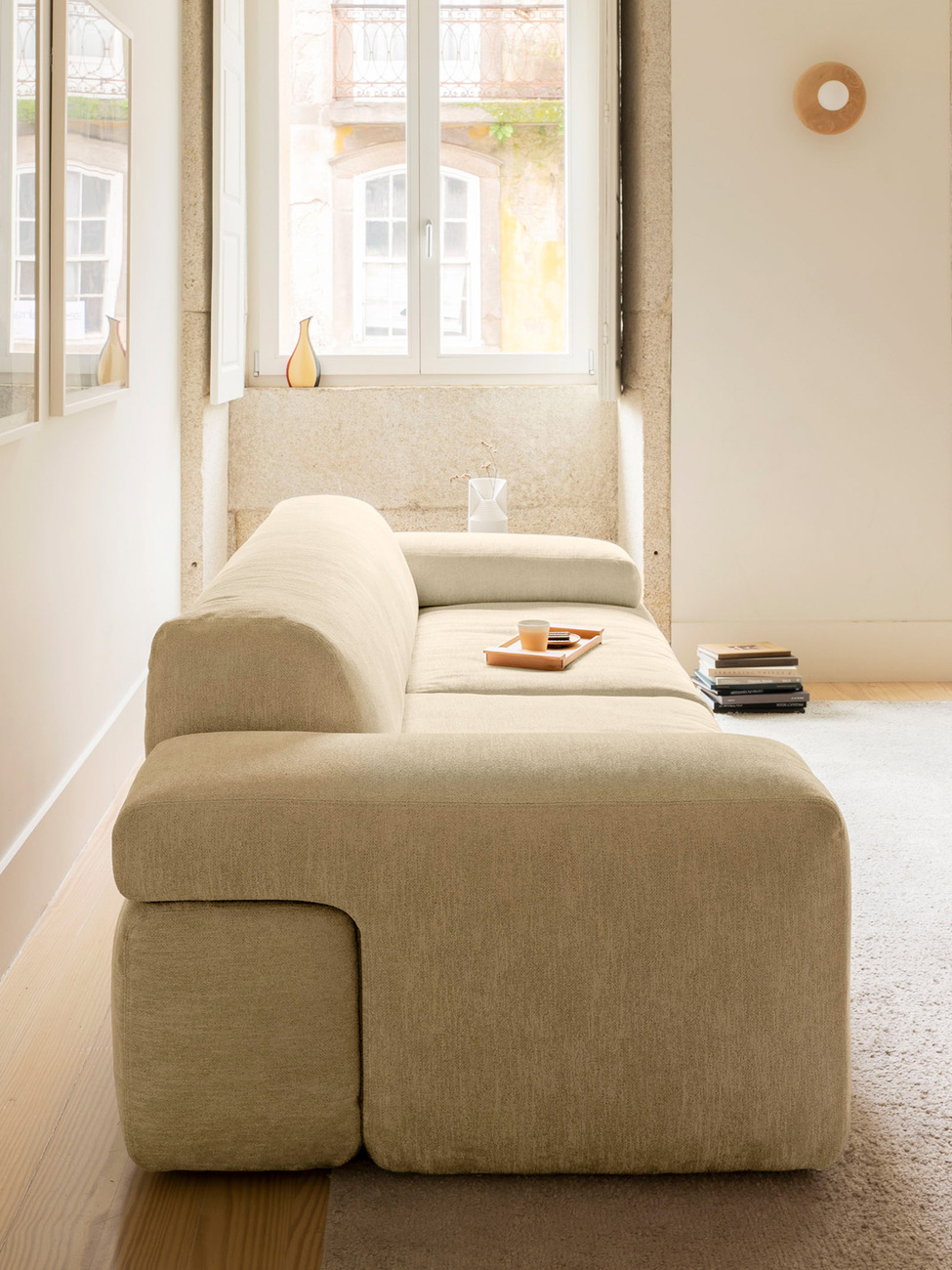
For the majority of the upholstered furniture on display, a low-slung design remained the order of the day, featuring generous proportions and rounded edges. There were also increasing references to natural forms, such as stacked stones: Gabriel Tan has developed the “Soft Stone Sofa” for ClassiCon, marking the Munich-based furniture manufacturer’s first sofa system. The eleven different modules consist of asymmetrically assembled upholstered elements, inspired by the staggered stone terraces in the Parque da Cidade in Porto. “Soma” by Bla Station also offers modular structures, a system and a durable layered construction for greater flexibility in both assembly and disassembly: A modular kit comprising two frames, two foam shapes, two protective covers and two tables opens up a wide range of configuration options. Among other things, Dedon presented “Tricot” by Barber & Osgerby, a modular lounging system whose elements can be combined to form sofas, L-shapes, U-shapes or daybeds. Freifrau adorned the “Marie” sofa by Hoffmann Kahleyss with an antique gold cover and, using a wide selection of individual covers for the “Ada” chair by Hanne Willmann, demonstrated just how much a piece of furniture’s character can be shaped by its cover.
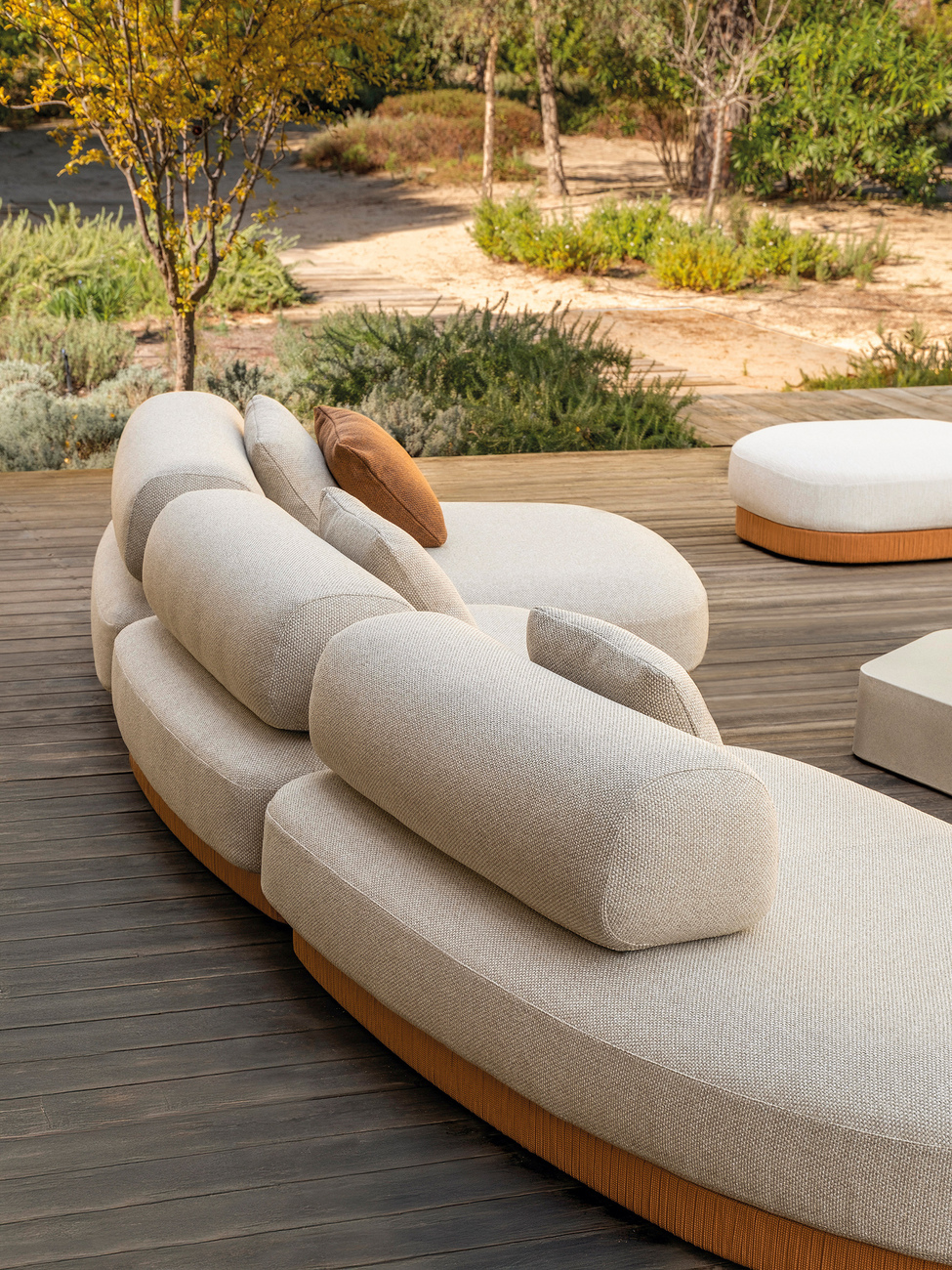
A decorative element that could occasionally be spotted was a band of leather or metal running around the piece, as seen on the “Meg” armchairs and sofas by Sebastian Herkner for Carpanese Home, where it serves as an armrest, or on the “Corsetto” armchair by Christian Mohaded for Molteni&C. Occasionally, the armrests of upholstered furniture were gently folded inwards, as seen on the “Olen” sofa by Yabu Pushelberg for Leolux. At times, the volume was allowed to spill over into amorphous seating landscapes, as with the “Loop” outdoor sofa by Elena Salmistraro for Ethimo, who describes her design as an organism. The new “Trace Island” sofa by Tableau also features a flowing form. The soft curves are intended to allow the entire surface of the seating to be utilised, whilst promoting conviviality and communication. For the colour schemes of the collections, warm pastel shades and natural, muted tones were predominantly chosen, whilst classic primary colours as well as mimosa yellow and burgundy were also seen more frequently. The white shade named “Cloud Dancer” by the Pantone colour agency, proclaimed as the trend colour for 2026, was thus thankfully given a lively contrast.
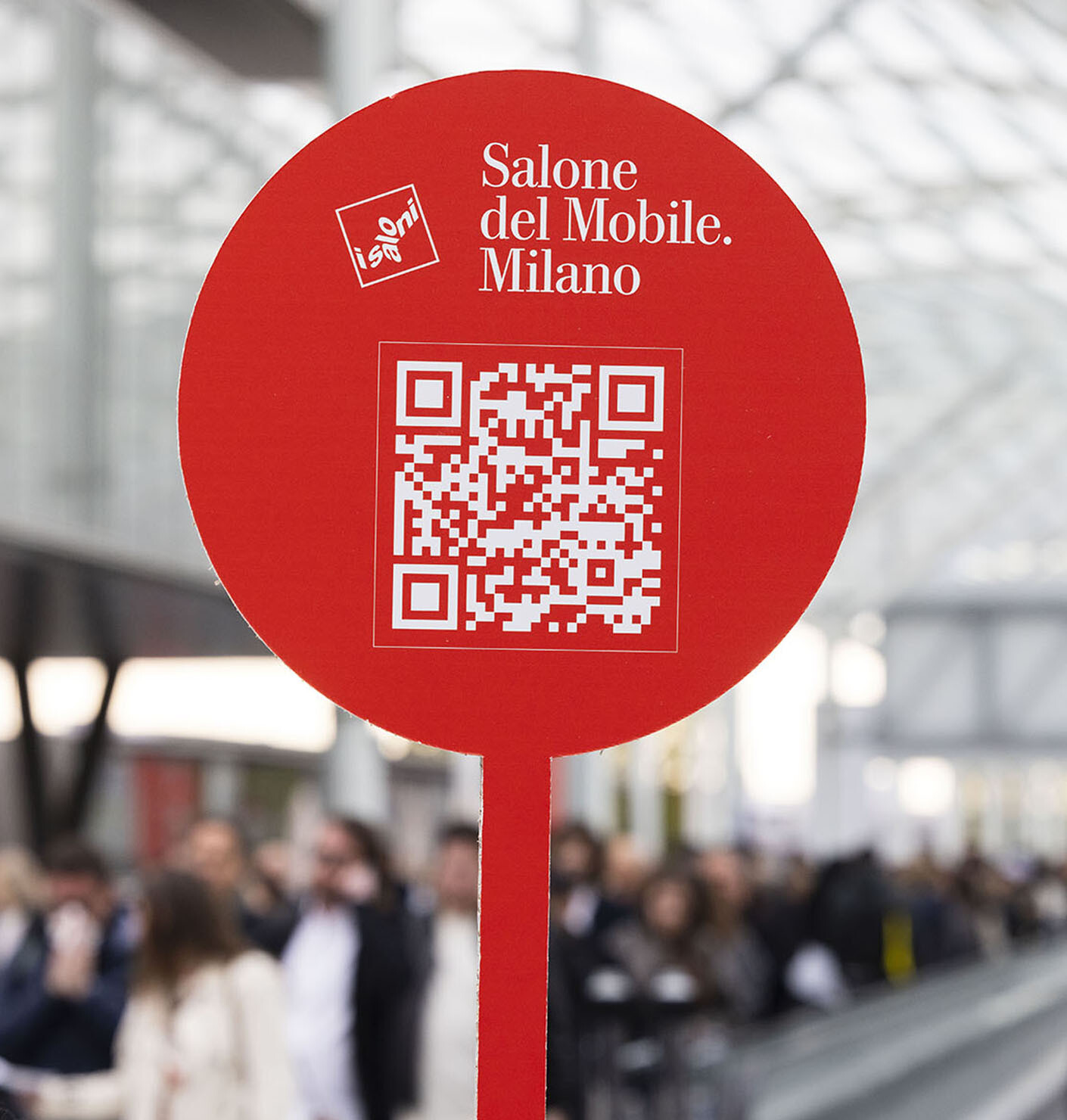
Whilst with most furniture you still have to laboriously search for the relevant information in data sheets, COR is already one step ahead: the company already offers the digital product passport, which will gradually become mandatory in the EU from 2027. Information about the product in question – be it dimensions, care instructions or assembly instructions – can be accessed via the label using a smartphone.
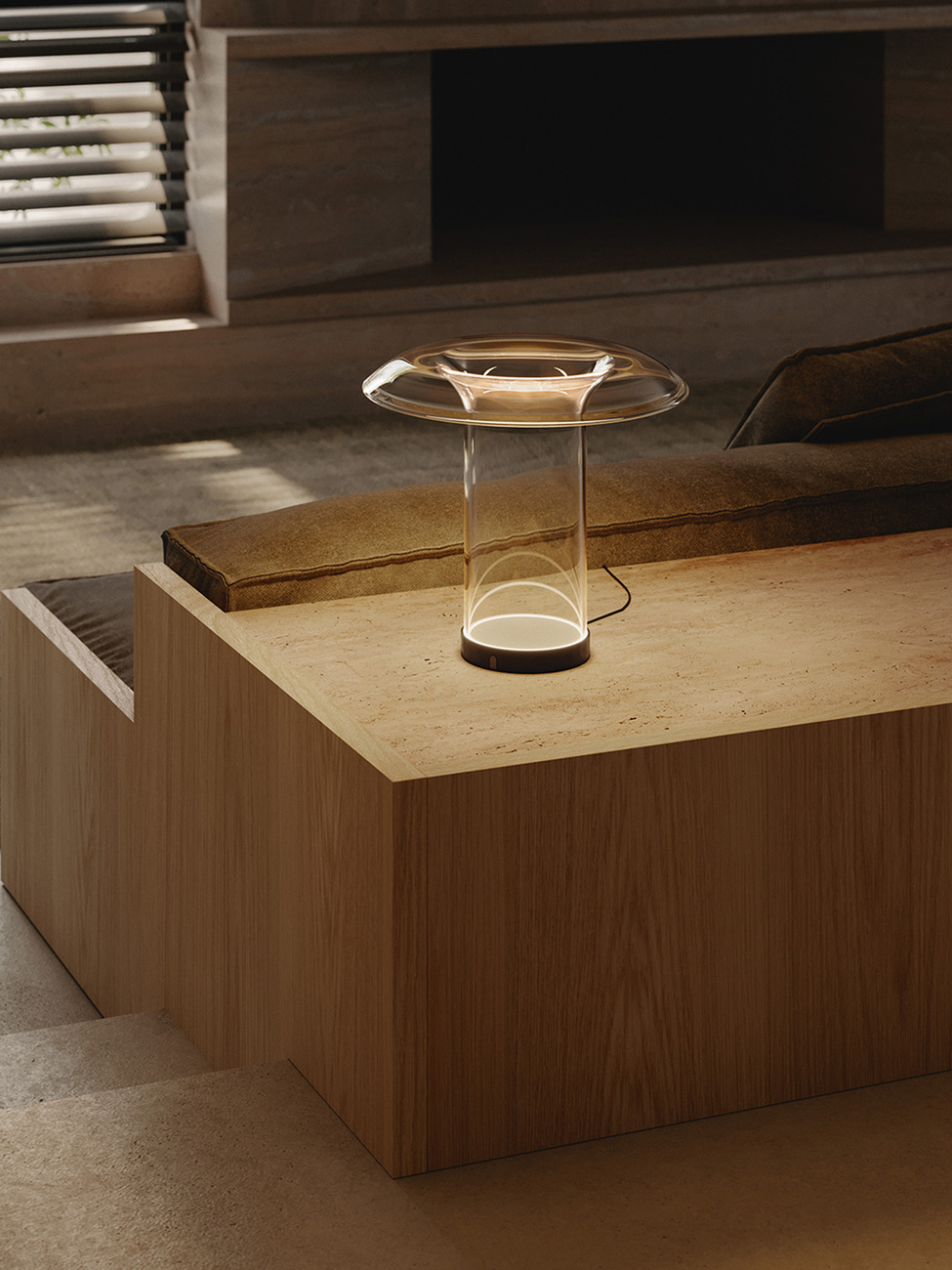
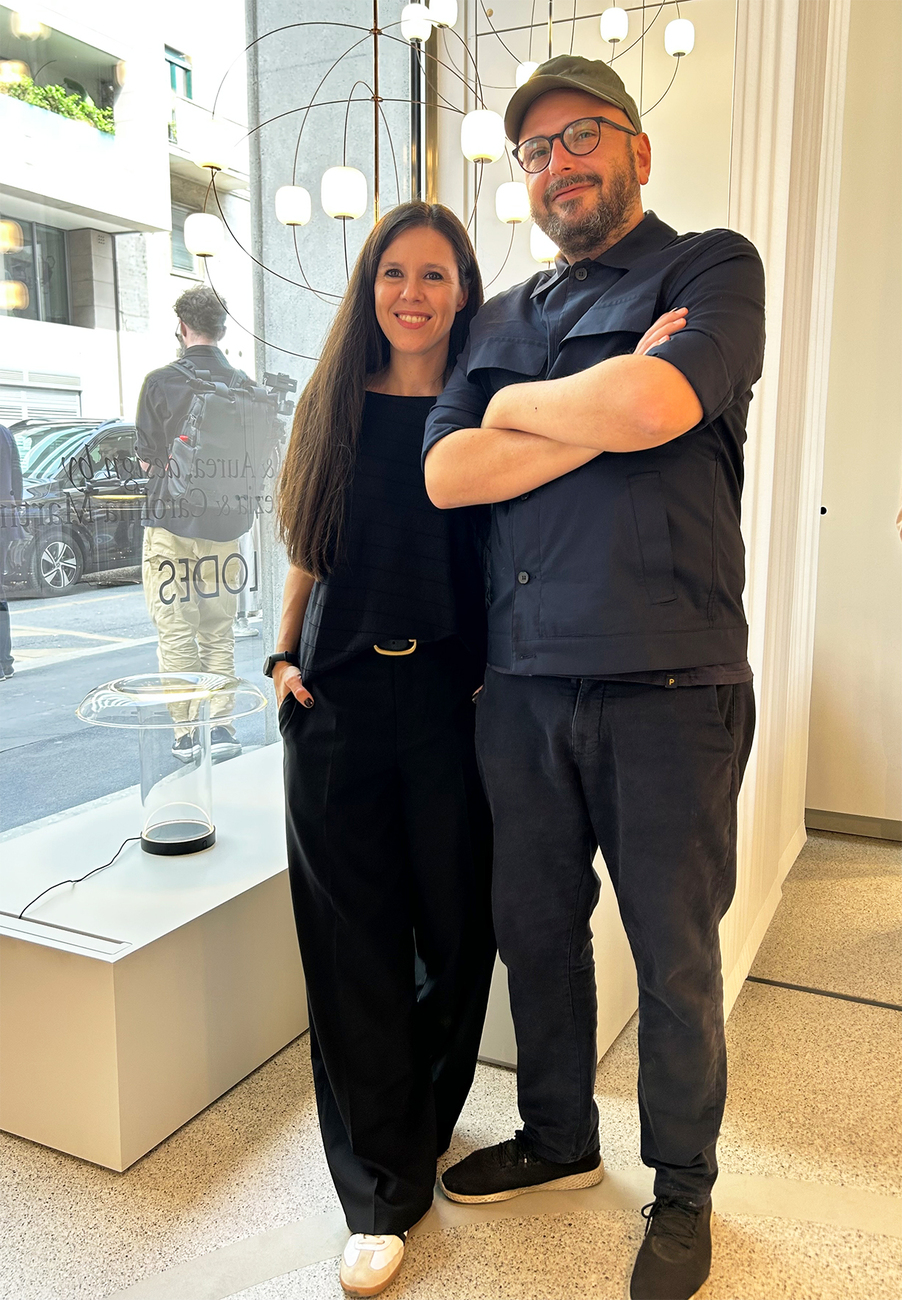
Meanwhile, the lighting manufacturers’ exhibitions focused on glass forms, concealed light sources and reinterpretations of classic designs, such as the chandelier. “Lopsi” by Umut Yamac for Luceplan features a ring to which support arms are attached in a radial arrangement, its shape resembling that of a lollipop. Lodes showcased the “Aurea” table lamp by Vittorio Venezia and Carolina Martinelli, an elegant glass diffuser in which light is evenly distributed from the base. The duo also designed “Axia”, a pendant lamp. The light is channelled through its structure rather than via the cable, enabling a slender and dynamic form. Lodes announced its strategic partnership with Unopiù on this occasion. For the “Boltons” table lamp by Herzog & de Meuron, Artemide employed a traditional technique in which a fine air bubble is trapped within the glass. A strategically placed lens at the base directs the light upwards, enabling precise control that allows the upper pane to reflect the light elegantly depending on its angle. The geometry of the glass gives Boltons a flexible range of movement for the upper reflector, which is secured with a magnetic ball.
Occhio presented “Coro moon” by David Kosock, a series of spotlights, downlights and pendant lights based on the “Occhio fireball” light source, offering precise, focused light that can be individually tailored. Fontana Arte returned to Milan with a new showroom designed by Franco Raggi, reimagining the former Nemo exhibition space on Corso Monforte. Brokis installed Lee Broom’s “Beacon” light installation in Piazza San Babila, which was first unveiled at the London Design Festival 2025. The design is inspired by Brutalist architecture and the legacy of the 1951 Festival of Britain, which was once hailed as a “beacon of change”. The glass elements were produced using a special melting technology that enables the recycling of discarded pieces. Once dismantled, the components can be reused as individual lights.
Rakumba presented “Torre” by Studio Pepe, in which form and lighting are combined into a geometric gesture. Experimental design and collectible design also received greater attention at the Salone del Mobile thanks to the “Salone Raritas”, featuring 28 galleries from 12 countries, curated by Annalisa Rosso and with exhibition design by Formafantasma. Among the highlights was “Plume” by Sabine Marcelis, which depicts a rising bubble in coloured cast resin. The work is the result of her extensive research into the viscosity of the liquid and the control of bubbles. It encapsulates the transformative relationship between material, light and colour that Sabine Marcelis continually explores. The Officine Saffi Lab and Hannes Peer offered direct insights into the craft of clay processing with a live performance. In collaboration with Margraf, Hannes Peer Architecture realised “La Casa di Marmo” beneath the garden of a historic villa in Brera: a setting made entirely of marble. Studio Bovti exhibited the “Cartapesta” tables, made of natural stone and papier-mâché, at the Galleria Rossana Orlandi, an exploration of material contrasts and our perception of weight.
In addition, the Salone used a series of talks and presentations to offer an initial glimpse of its new “Salone Contract” initiative, designed by Rem Koolhaas and David Gianotten / OMA, which goes beyond the mere presentation of products. The aim is to provide a market-oriented infrastructure with a focus on the contract sector. “The forum at Salone 2026 offers us the opportunity to open a dialogue about this ecosystem: who are the players, what roles do they play, what do they need, and how do they relate to one another? Through a series of discussion sessions, we aim to make this landscape visible and accessible to a wide audience and highlight the opportunities it holds,” said David Gianotten of OMA in advance in an interview with Stylepark. The contract area at the Salone del Mobile is set to be unveiled in 2027. The project, led by Maria Porro and OMA, aims to build a bridge between furniture manufacturers and the contract sector, such as the hospitality industry, real estate and public spaces.
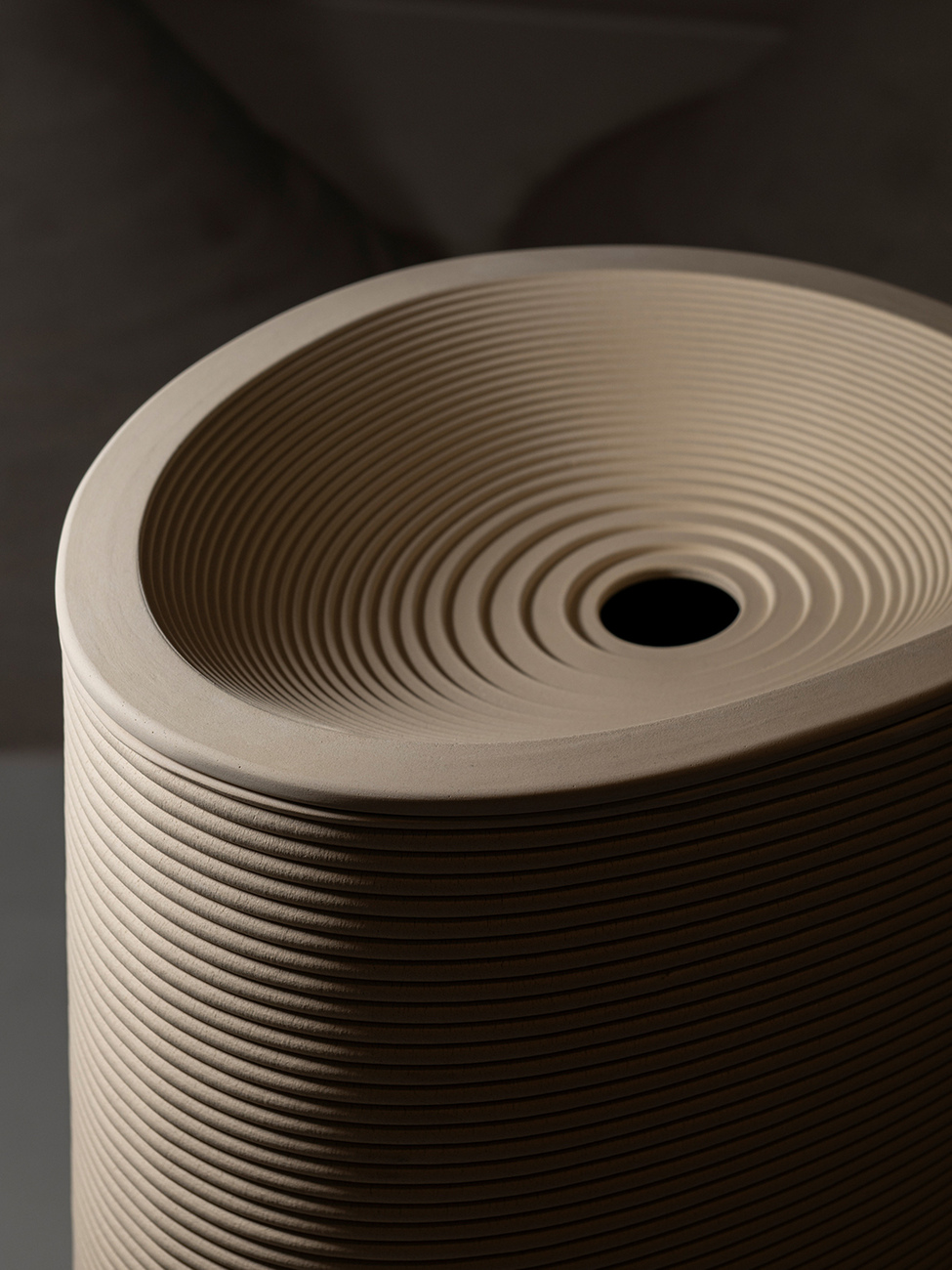
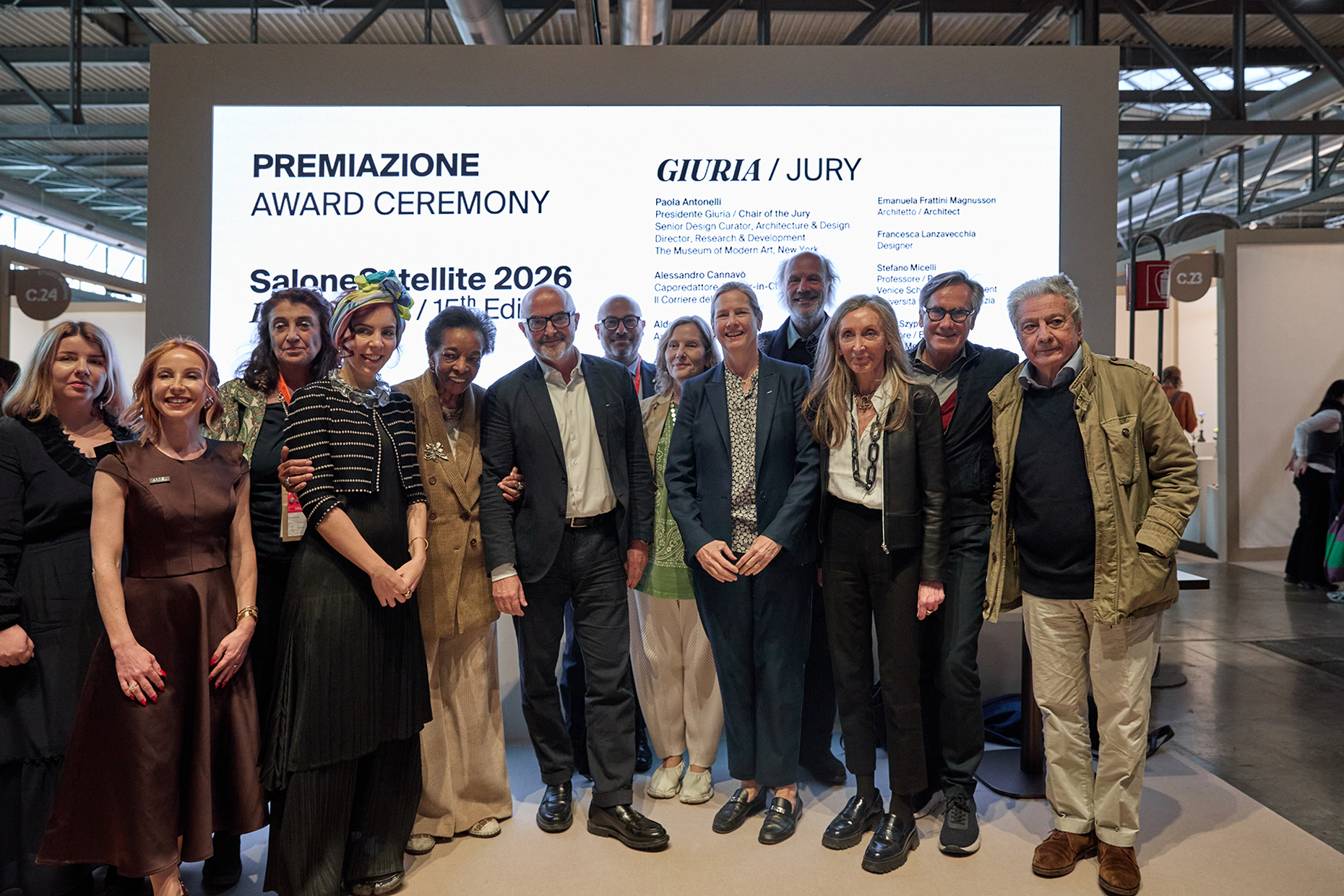
The young talents exhibiting at SaloneSatellite presented a shared vision of design as an interface between technological innovation and material culture. This year, the Danish studio Russo Betak won first prize at the 15th SaloneSatellite Award for its hand-formed “Nippon” lamps, in which it translated its innovative material research using shells and 3D printing into a layered structure resembling paper. Second prize went to the Dutch IOUS Studio for “3DP Ceramic Tiles”, which explores the potential of digital manufacturing through a sustainable and application-oriented approach. The clay is produced using a computer-controlled 3D printing process. Third prize was awarded to the German studio Jüngerkühn for the “Soft Touch” porcelain vases, in recognition of their balance between technological precision and tactile quality. Special mentions went to Aiko Design from Chile for the “Númina Lamp” and to Yixian Wang from China for “Foggy”, an expressive experiment with glass.
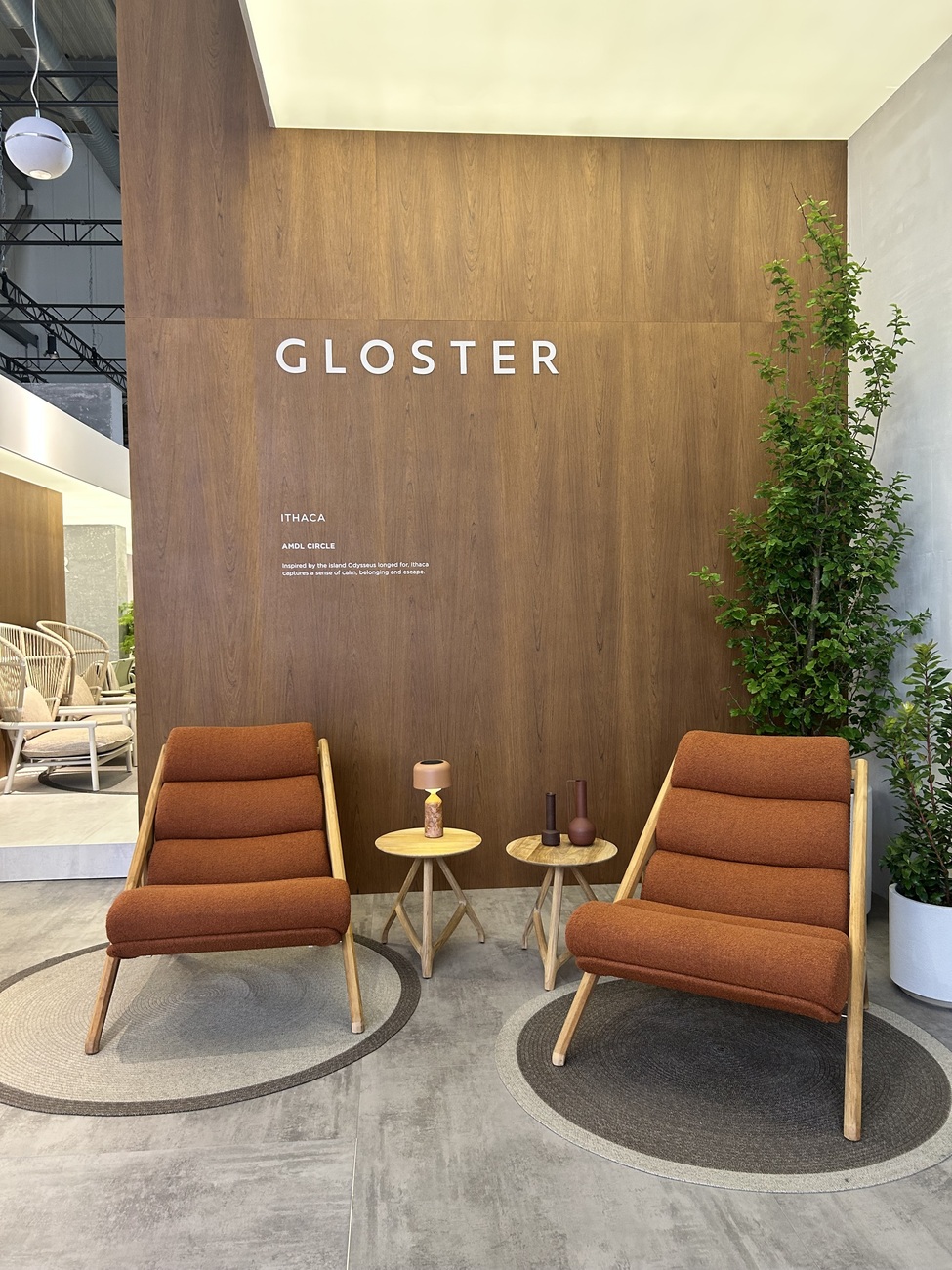
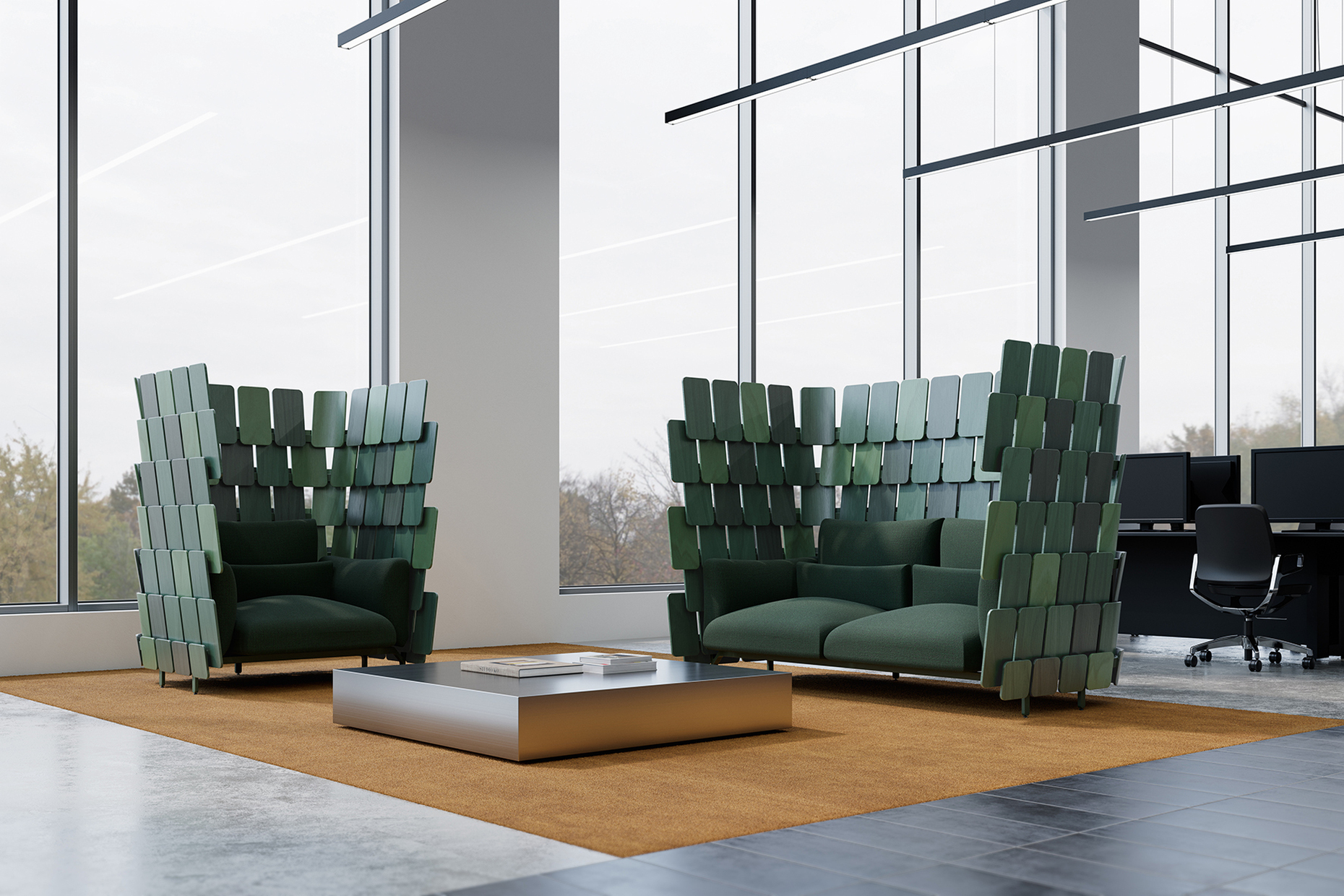
Design concepts from architectural firms were increasingly on display in the halls of the Salone del Mobile and at Milan Design Week: Norm Architects presented ‘Brae’ for Expormim, a modular outdoor sofa system with gentle curves and an adjustable backrest. For Inbani, Norm Architects designed the “Materia” bathroom collection, featuring the rhythmic grain patterns of carved wood incorporated into natural stone as reliefs. Philipp Starck conceived “Hotte” for Cassina: inspired by the craftsmanship of traditional wicker baskets, the armchair has a rattan frame resembling hand-woven wickerwork and is fitted with cushions made of soft Voyage leather. For the crystal glass manufacturer Arnolfo di Cambio, AMDL Circle designed the “Butterfly” cocktail set. For Gloster, Michele De Lucchi’s team created the “Ithaka” collection, comprising a lounge chair, sofa, ottoman and side tables. The focus was on the search for tranquillity and a balanced, serene design language. For NII, De Lucchi created “Pigna”, which serves as both a room divider and a sofa. With its characteristic shingle-shaped panels, it discreetly screens the seating area from view whilst allowing light and air to pass through. The collection offers three models depending on the desired level of privacy.
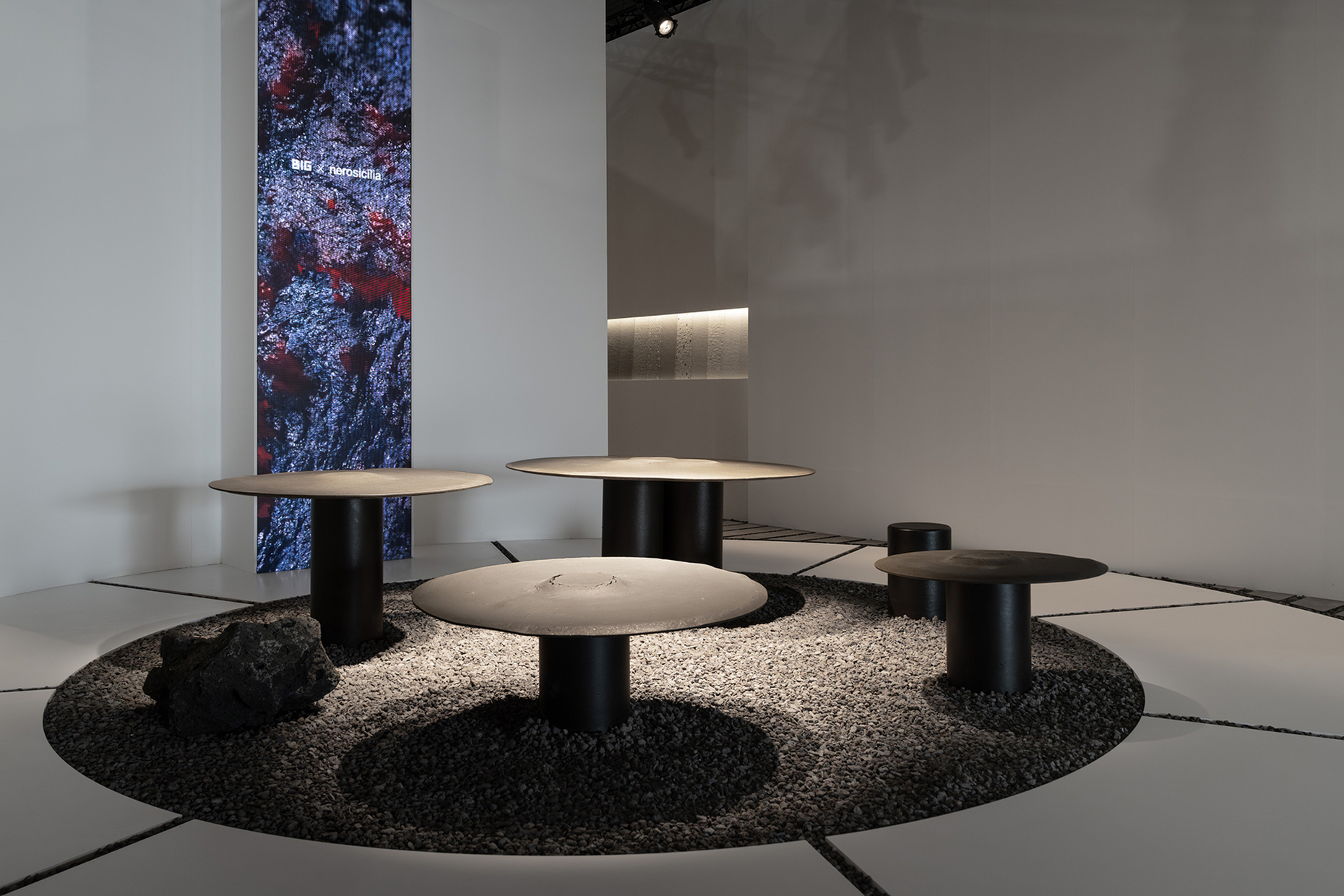
AMDL Circle shares a special bond with Pedrali: following the Pedrali Pavilion, designed by AMDL CIRCLE and Michele De Lucchi to mark the company’s 60th anniversary and which hosted the exhibition “Pedrali60, we design a better future” curated by Luca Molinari Studio, the “Fibra” collection demonstrates just how elegant sun loungers made of wood and aluminium can be. Molteni also presented the exhibition “Il Conforto dell’architetto / The Architect’s Relief” at its Palazzo, dedicated to the work of Michele De Lucchi and realised in collaboration with the Milan-based gallery Antonia Jannone Disegni di Architettura and Francesca Molteni. The forty or so works, shown in Milan for the first time, emerged from fundamental questions regarding the role of architects. Nerosicilia and BIG presented “1669”, a collection of dining and coffee tables made from lava stone. Nerosicilia, meanwhile, played a key role in the development of the “SensiEtna” surfaces, a collaboration between Florim and Matteo Thun & Partners, for which lava was combined with the colouring of the minerals contained within the volcano.The prize was awarded to the German studio Jüngerkühn for the “Soft Touch” porcelain vases, in recognition of their balance between technological precision and tactile quality. Special mentions went to Aiko Design from Chile for the “Númina Lamp” and to Yixian Wang from China for “Foggy”, an expressive experiment with glass.
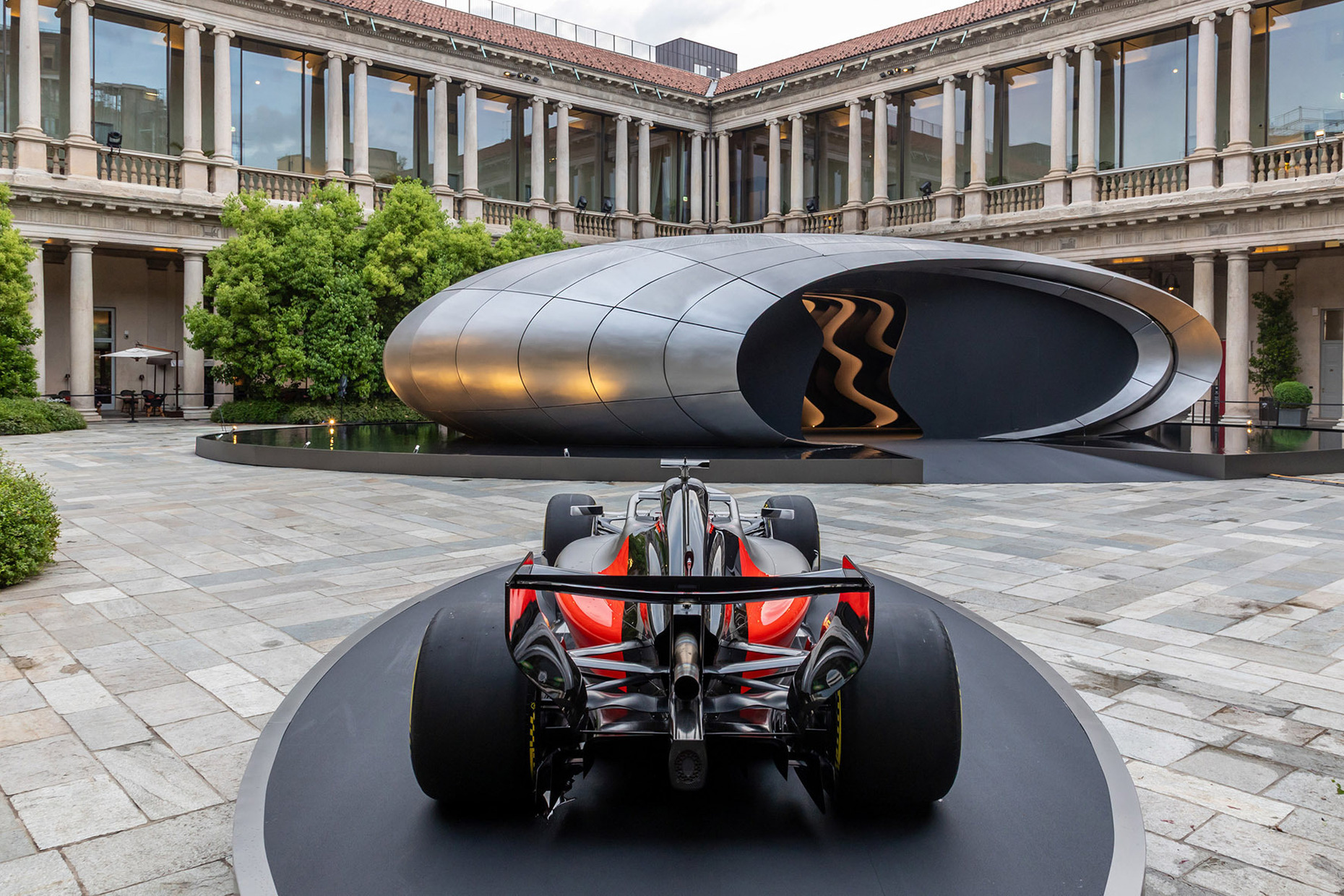
Foster + Partners presented “Beam” and “Column” for Punt Mobles – a flexible shelving system and a range of tables that complement one another – as well as the modular furniture system “Area” for Kettal. Zaha Hadid Architects designed the “Aeris” collection for Citco, which transforms heavy materials such as metal and glass into fluid-looking forms and offers structures that oscillate between architecture and product design. The underside of the table is hollowed out into lattice-like geometries, the edges of which taper sharply towards the bottom. Meanwhile, at the Salone Raritas, the tables from Zaha Hadid Architects’ “The Erosion Collection” for Neutra were on display. Furthermore, the team presented the walk-in installation “Origin” in the city’s Piazza del Portrait Milano, whose futuristic form symbolised a portal to the new era of Audi design.
Amidst the hustle and bustle of Milan Design Week and the city’s buzz, finding a moment to reflect was a theme that featured in many installations, such as the concept for “Metamorphosis” by Mosca Partners and Lina Ghotmeth – a pink labyrinth in the courtyard of Palazzo Litta designed to invite visitors to adopt new perspectives. To promote the radical act of slowing down and mindfulness in an ever-accelerating world, Annabelle Schneider x Snohetta x USM created “Renessaince of the Real”, a multi-sensory installation in which touch, sounds and images help visitors find peace and immerse themselves in the present moment. The installation explored presence, perception and the value of physical experience in a hyper-connected world. “The USM grid is both an anchor and an invitation. Our design explores the tension between the grid-like and the amorphous, creating a permeable boundary that filters the outside world and directs attention inwards – towards light, nature and the quiet presence of others,” says Anne-Rachel Schiffmann, Head of the Interior Architecture Department at Snøhetta.
“Il Sonno Supermarket” by SolidNature x OMA & AMO used stone artefacts shaped like food to question the lack of mindfulness in the routines of our Western throwaway culture. Atelier Oï and Geberit created the sensory installation “RŌS” for the new Geberit Experience Centre in the Tortona district, in which delicate stainless steel springs guide the movement of water, realising a graceful choreography of nature and technology. Preciosa Lighting created a fascinating atmosphere of light and colour in the installation “Drifting Lights” using 60 bubble glass panels. Herzog & de Meuron’s new “MTM – Made to Measure” collection for UniFor was showcased as part of “Non Places”, an installation conceived by Studio Klass at Spazio UniFor. An abstract space with red accents, designed to accommodate the product rather than dictate it. “Today everyone wants to provide an answer, but this time the aim was to leave the discussion open,” said Marco Maturo of Studio Klass.
Many installations this year opened up spaces that would otherwise remain closed to the city’s visitors. The Salone del Mobile.Milano itself contributed to this, opening up numerous historic design and architecture archives in Milan to the public for the first time through the Common Archive – La Notte Bianca del Progetto initiative, featuring guided tours and lectures. Forgotten Architecture also presented, in collaboration with K-Way, an architectural guide to Milan, which included a visit to the Biblioteca Sormani in the impressive Palazzo Sormani. 6:AM presented “over and over and over and over”, a dialogue of space, glass and architecture in the historic Piscina Romano – a former swimming pool designed by Luigi Lorenzo Secchi in 1929. Within it, lights became sequences, and coloured glass modules formed walls. Alongside the existing collections, the exhibition brought together a series of objects being presented for the first time, including “Batch” – the hand-blown glass cubes originally designed for the set of the Bottega Veneta Summer 2026 fashion show – as well as a new limited edition of the “Paysage” and “Lina” collections, developed in collaboration with Hannes Peer.
The Grand Spectacle
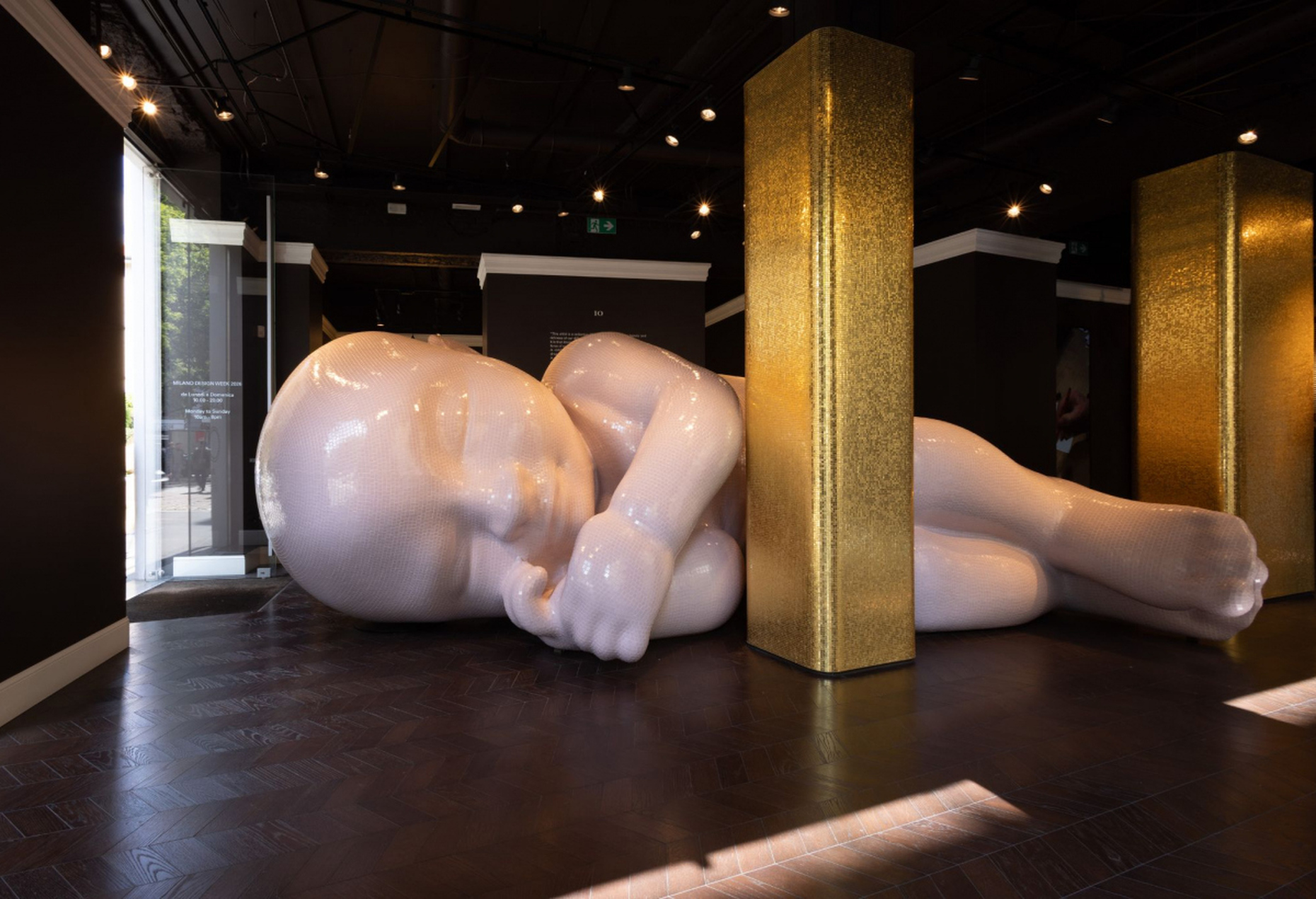
The growing desire for light-heartedness was evident in many playful settings designed primarily for instant impact and light-hearted entertainment: Guests were invited to take a seat on oversized replicas of vegetables and fruit in the carousel created by Laila Gohar and Arket, whilst Asics created a kinetic play area for its Salone debut in collaboration with Nuova Group, Moncler had a giant octopus sculpture grow through Corso Como 10, whilst Skoda and Ulises Studio transformed the courtyard of the Palazzo del Senato into a dynamic setting for their product presentation, featuring inflatable structures under the title ‘Ooooh that’s EpiQ!’, complete with a slide, foam bath and dance show. For "Serotonin: The Chemistry of Happiness”, inflatable forms to grow through the loggia of the Pinacoteca di Brera, which slowly expanded and contracted as if they were breathing. Creative Director and Designer Stella Stone and Carlotta Orlando of Giglio Tigrato placed a giant hand-sewn pachyderm in the room for the Deoron exhibition under the title “The Elephant in the Room”. Bisazza presented “Io” by Fabio Novembre, a monumental mosaic sculpture depicting the peacefully sleeping body of a baby, as well as “Felicidades” by Jaime Hayon, a colourful mosaic artwork that was recreated as a cake for the occasion by pastry chef Ernst Knam. In keeping with the current 90s retro trend, Ikea added an armchair with a metal frame and inflatable cushions by Mikael Axelsson for the Ikea PS 2026 range to its collection. Kia’s exhibition “Opposite United – Journey of Reflection” offered a cave-like, fluffy backdrop that alternately gave visitors the feeling of being immersed in a cloud of pink candyfloss or stranded on an alien planet.
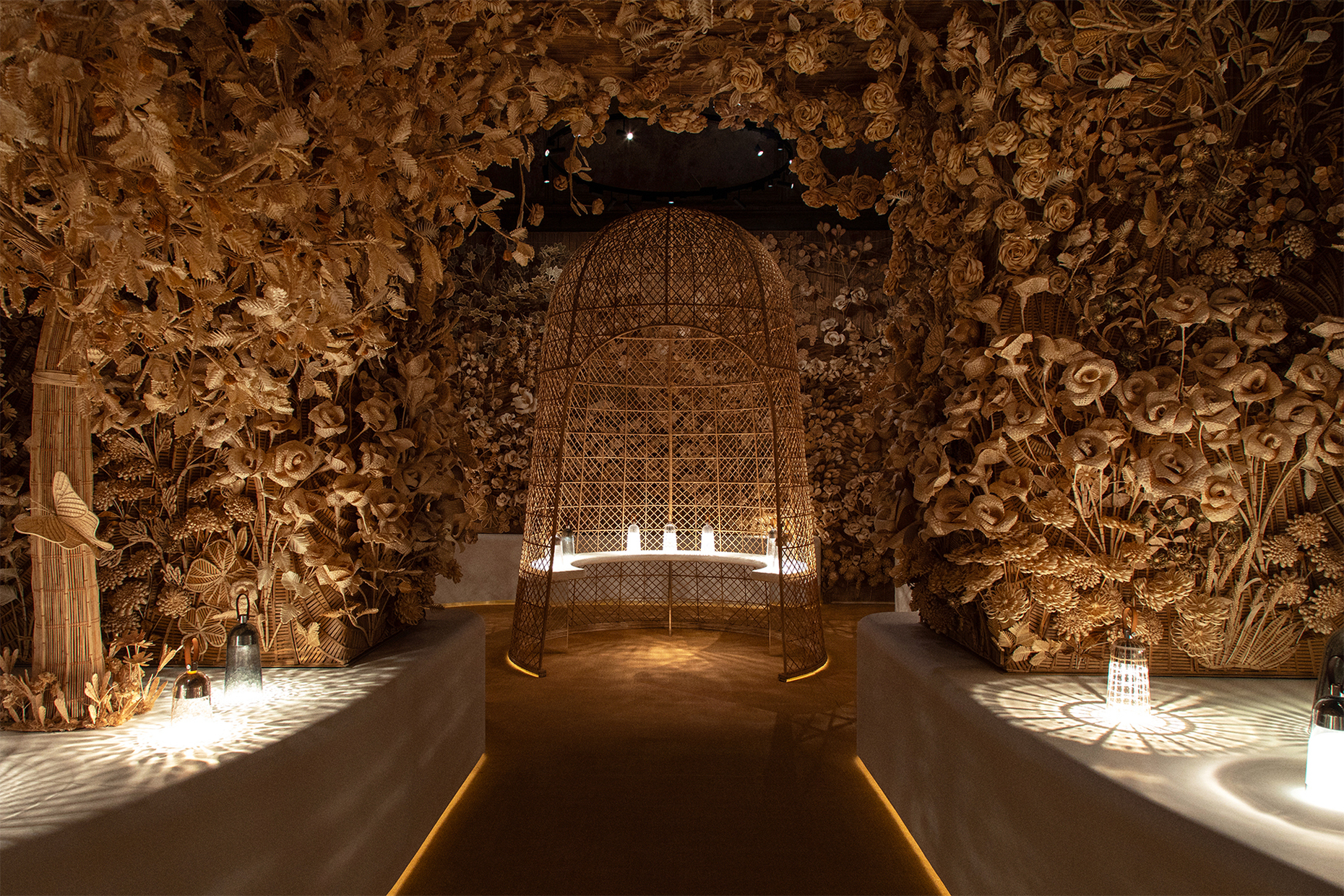
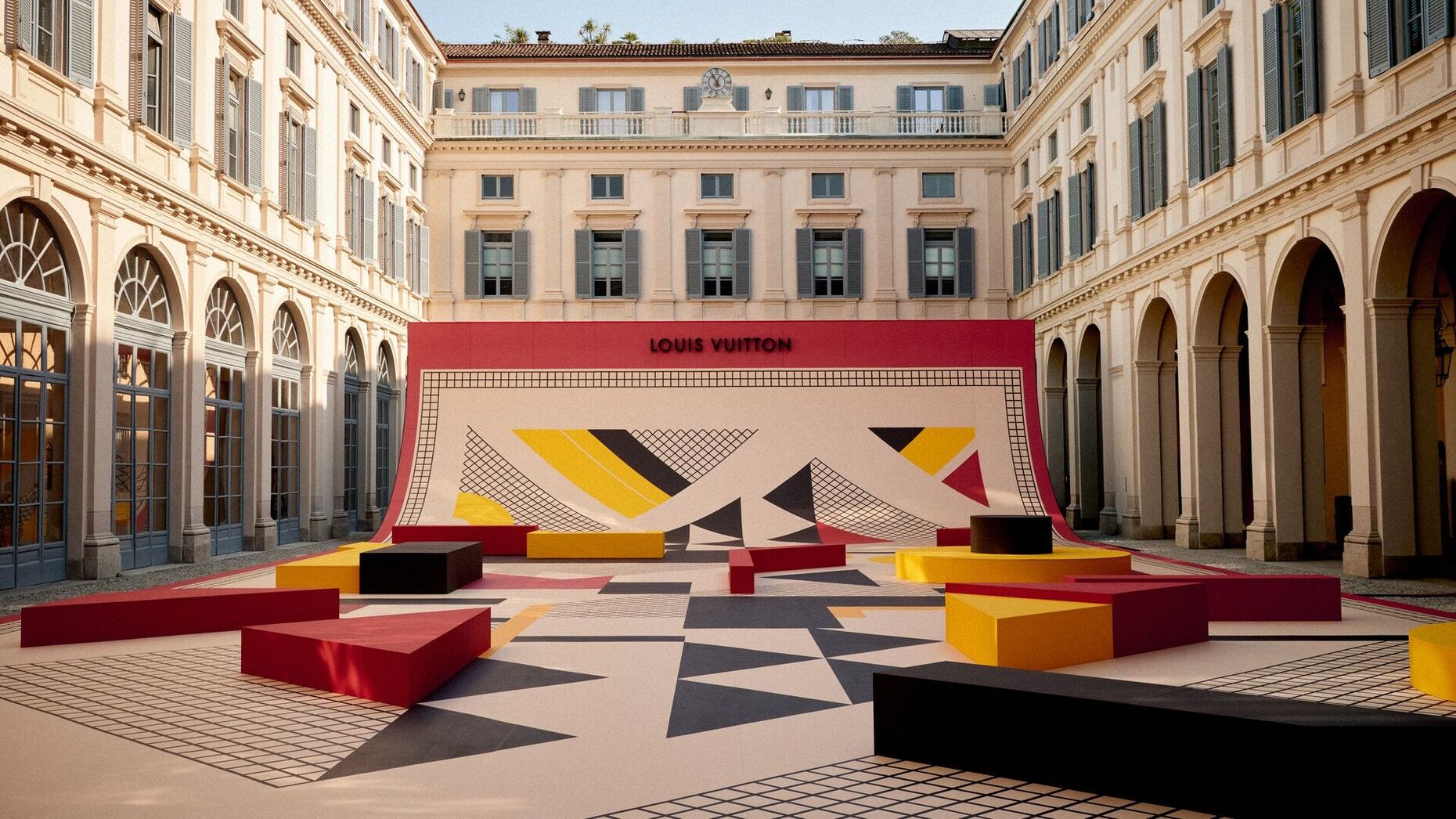
Overall, Milan Design Week seemed more commercial than in previous years. Alongside numerous car brands such as Audi, Škoda, Mercedes and Mini, luxury fashion brands also made a reliable return to Milan with lavish exhibitions that lent themselves well to social media promotion. Gucci invited guests to Demna’s “Memoria” garden installation at the Chiostri di San Simpliciano, whilst Louis Vuitton showcased “Objets Nomades” at the Palazzo Serbelloni and reissued Pierre Legrain’s Art Deco furniture from the 1920s, including the fashion brand’s first piece of furniture, the “Celeste” dressing table. Hermès presented new home collections at La Pelota as usual; at Dior, Noe Duchaufour’s glass lamps were on display against a detailed, floral backdrop of wickerwork; Jil Sander x Apartamento selected sixty books for a personal library, whilst MCM celebrated its 50th anniversary with an intergalactic sound experience, complete with a 1970s-style spaceship by Atelier Biagetti. To mark Milan Design Week, H&M Home made its debut in Milan in collaboration with Kelly Wearstler. The two-part installation “The Paper Log: Shell and Core” by Issey Miyake and Ensamble Studio, which transformed a by-product of the pleating process into paper objects and furniture prototypes, offered a welcome respite for both the mind and the eyes amidst so many visual spectacle effects.
Queues, sometimes stretching along entire streets, and stricter access restrictions became the norm at many exhibitions; even the press had to go to the trouble of booking an “appointment” in advance, as was the case with Molteni. Extensive data as the currency for access to showrooms, VIP lists and, in some cases, admission to the shows – Milan Design Week has long since ceased to be democratic. The event’s international reach attracted noticeably more brands this year that have little to do with design but would like a slice of the Milan design pie, regardless of whether they already successfully operate their own platforms: be it the luxurious displays of fashion brands, the hollow installations by vape suppliers, or McDonald’s, which set up a ball pit in Milan to mark its 40th anniversary in Italy.
Fortunately, alongside the growing spectacle of commercialism, the city still offers a few spaces for a counterbalance, for change with substance. In the five-storey Convey Building, which describes itself as “The Leading Event for the new wave of design companies”, visitors could see, amongst other things, an installation by Terraformae and From Lighting: whilst From Lighting reinterprets classic forms of lighting, Terraformæ is the research laboratory of Fornace S. Anselmo. Together, they explore new, sustainable ways of elevating terracotta to a contemporary design language. Also featured in the Convey exhibition was the Bosnian company Woak, which specialises in the manufacture of solid wood furniture – such as the “Pluri” system by Naessi or the Houdini stool by Antonio De Marco. Also of interest were the luminaires by the design and research office IIode, founded by Jean Besson, Jonathan Mauloubier, Patrick Morris and Lucas Uhlmann.
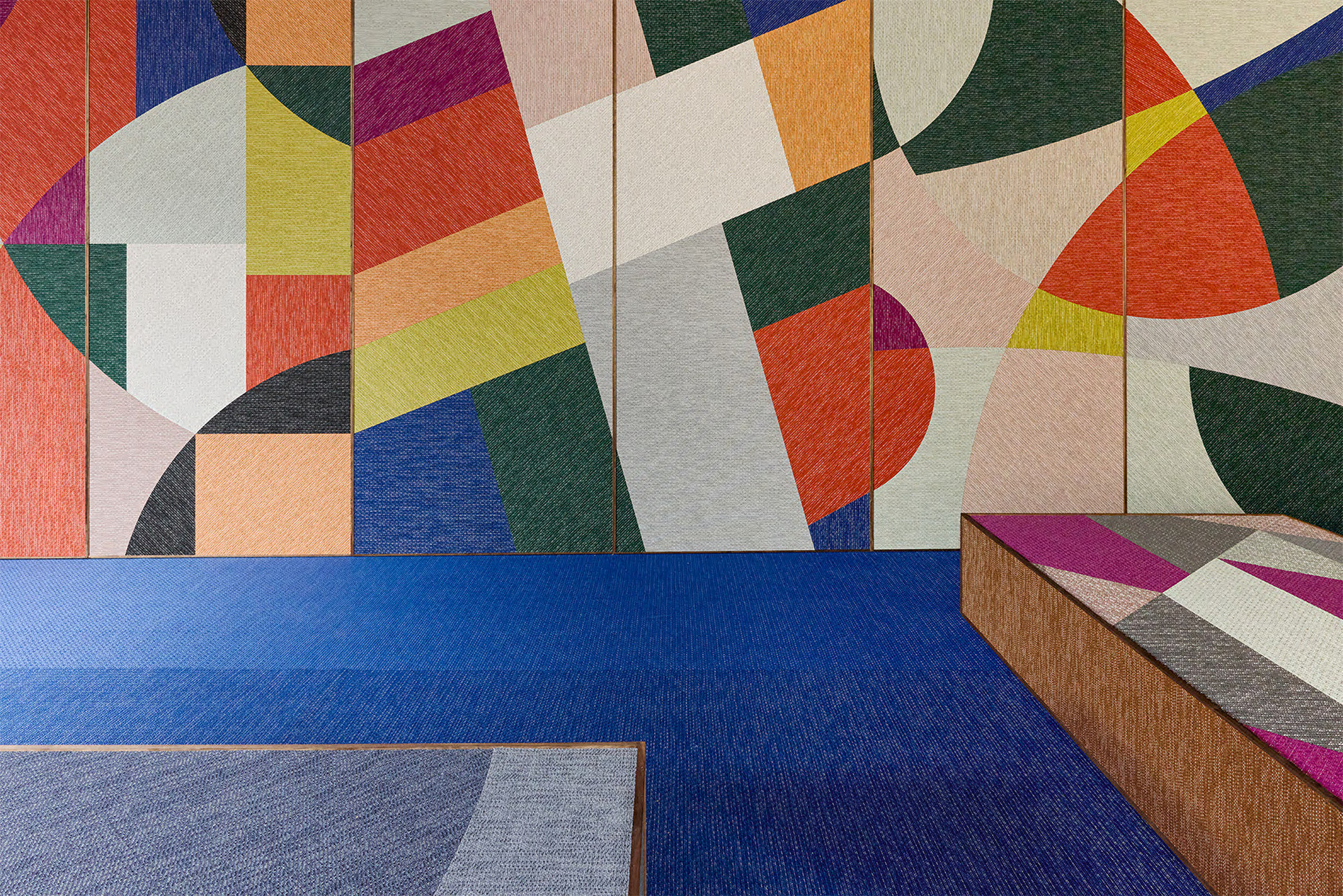
Further examples of design that breaks with uniformity were showcased in the Loreto/Porta Venezia district by the curated design and lifestyle platform Deoron, such as the “My Ami” sideboard by Victor Foxtrot from Hamburg: the top and base form a T-shape, whilst the front view brings together the soft shapes of an oval, a circle and a rounded square. Colour plays a key role in the design: both the top and the base consist of three layers, which are revealed in the base through gradually smaller circular cut-outs. The interplay of these layers creates visual depth and makes the piece appear different from every angle. Meanwhile, at Capsule Plaza, visitors were invited to the Bolon Studio, a space for creative practice where the artistic collaboration with Italian designer Martino Gamper was presented. Under the title “Riquadro”, ten works were on display, exploring the intersection between functional design and conceptual art.
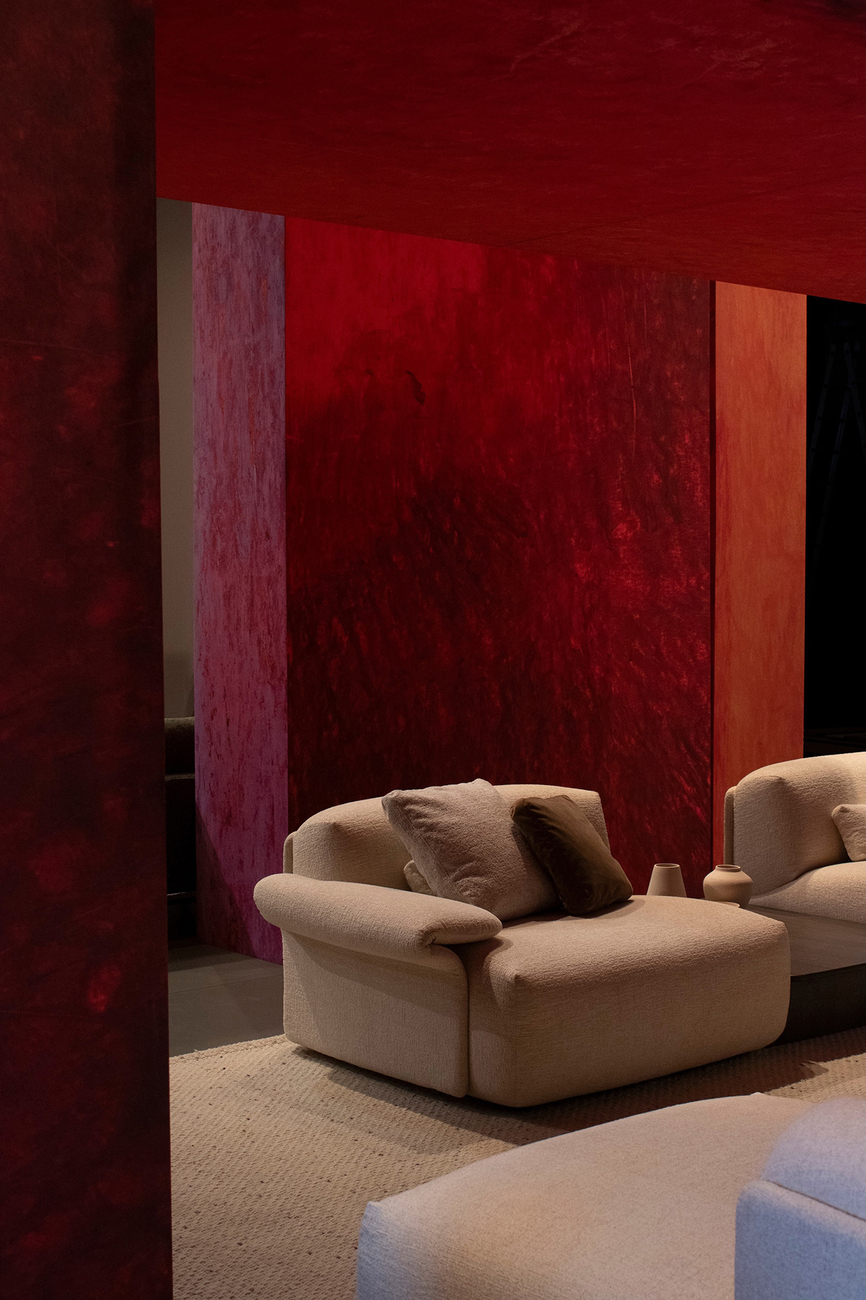
A highlight was “When Apricots Blossom”, the first exhibition by the Uzbekistan Art and Culture Development Foundation (ACDF) at Milan Design Week, curated by Kulapat Yantrasast, founder of WHY Architecture. Part of this was an oversized garden pavilion by WHY Architecture, a “deconstructed yurt” inspired by the region’s nomadic heritage, where talks, workshops and special events were held. In addition, a design exhibition at Palazzo Citterio traced the transformation of the Aral Sea region. Also worth seeing: the Visteria Foundation’s exhibition “Polish Modernism. A Struggle for Beauty” by the Visteria Foundation, curated by Federica Sala and Anna Maga, which, on the 16th floor of the Torre Velasca, placed historical works in dialogue with contemporary objects and highlighted how modernist thinking continues to exert a significant influence on Polish design culture to this day. Meanwhile, the “Le Design Défilé – French Design in Motion” project presented a scenographic installation in Brera, designed by Jakob+MacFarlane, offering a contemporary perspective on French craftsmanship. Also impressive was the conceptual textile installation “Ai Weiwei: About Silk” for and with Rubelli: an immersive Gesamtkunstwerk for which a room was completely clad in silk fabric in deep red and golden yellow, which the Chinese artist had adorned with motifs critical of the government that, at first glance, appear to be ornaments. Visitors could explore historical fabrics and a previously unreleased documentary film, shot specifically for this occasion by the Argentine director Felipe Sanguinetti.
Konstantin Grcic once again demonstrated his talent for combining complexity and clarity in a design that focuses on the essence: at the Laufen space in Milan, dedicated to the future of bathroom design, he presented the exhibition “When Time Becomes Material”. For this, he embedded his new “PAR” collection within a cylindrical wooden structure, which created a tranquil environment within the rectangular showroom. “PAR” offers understated pieces that are intuitively understandable and encompasses ceramics, accessories, furniture and “FIL”, a new range of taps. At the centre of the presentation stood a sculptural seating piece by Simon Stanislawski, a former student of Grcic’s at the HfbK Hamburg, crafted from recycled mattress foam. Bathed in an intense Yves Klein blue, it evoked the connection between past, present and future. Villeroy & Boch and Ideal Standard presented “Design Continuum” in their converted showroom, an immersive installation developed in collaboration with Studio Elastique, showcasing, among other things, the “Artis Sense” washbasins by Christian Hass, the “Vea” tap and a colour concept by Gesa Hansen. The installation was conceived as a dialogue platform exploring how design shapes perception and influences our senses. At the heart of this narrative was the prototype of the monolithic “Antao 3D” washbasin, a material study developed by Kaschkasch and produced using 3D printing from recycled ceramics. Meanwhile, Patricia Urquiola designed the purist “Balcoon” series for Duravit, featuring round and oval washbasins set upon a square pedestal.
Cristina Celestino designed “Segnature”, a collection of porcelain stoneware for Florim, inspired by the patterns of crepe paper and the fine veins of leaf structures. Davide Groppi recounted his success story through luminaires, light installations and scenographic insights. The exhibition, curated by Marco Sammicheli, showcased a series of installations tracing more than forty years of creative work. At Wagner Living, visitors could experience, among other things, the “d2” interior system with its patented plug-in connector, which is available in 100 per cent recyclable cardboard or elegant aluminium and, as a space-defining system, offers a flexible and sustainable complete bespoke interior solution. At Milan Design Week 2026, Dornbracht and Jung presented the next step in their collaboration: at Light+Building 2026, the two manufacturers launched a bronze-coloured real metal finish. This visually and tactilely links Jung’s switch ranges with Dornbracht’s fittings. Five further metal finishes were now unveiled in Milan.
For the first time, the German outdoor company Garpa was represented. As part of the curated exhibition ‘Menu by Bodo Sperlein’, the company presented two high-performance jacquards manufactured in Italy, which were developed specifically for outdoor use. To complement the fabrics, Bodo Sperlein, Gravelli and Godelmann designed the ‘Arcus’ seating series, consisting of a bench and a stool. The collection combines the architectural materiality of concrete with the natural warmth of teak. Thanks to the softly curved silhouette, the solid materials were given an apparent lightness. Naturally, a visit to the Bocci Apartment on Via Giuseppe Rovani was a must during Milan Design Week: the exhibition “Light as Medium”, curated by David Alhadeff, presented a series of site-specific installations by Omer Arbel, conceived as standalone works and staged in an exceptionally striking manner.
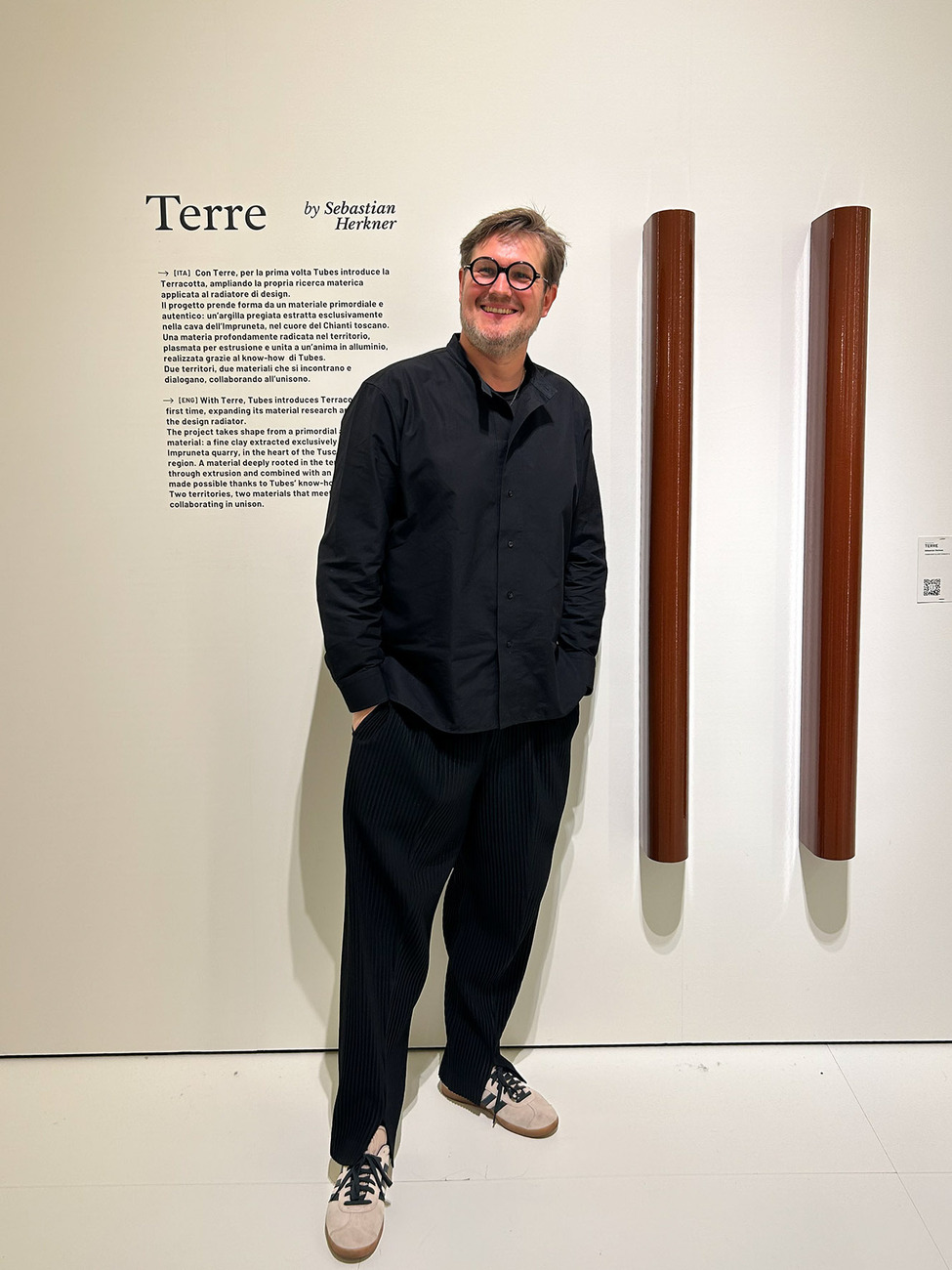
Meanwhile, at the Salone del Mobile, Desalto presented an optical illusion with “Helicon” by Kensaku Oshiro: the table’s lines are reminiscent of the flared end of an upturned trombone. A thin metal foil is transformed into a continuous profile that creates an impression of visual depth beneath the glass top. In general, column-shaped table legs, usually supporting a top with rounded edges, were a popular stylistic element at the shows. With “Terre” by Sebastian Herkner, Tubes introduced terracotta into the “Elements” collection for the first time, thereby expanding its material research in the field of designer radiators. Terre, Italian for “earth”, is an electric radiator that originates from the earth and pays tribute to it in its very name. The fine clay is sourced exclusively from the Impruneta quarry in the Chianti region of Tuscany. Among other pieces, Established & Sons presented the light sculptures “The Original Maya Collection” by Luiza Guidi and the “LayUp Lounge Chair” by Nathan Martell. For the latter, the possibilities of 3D-moulded veneer technologies were explored to seamlessly shape complex, multi-part constructions from moulded veneer and a core of bamboo plywood into a single form.
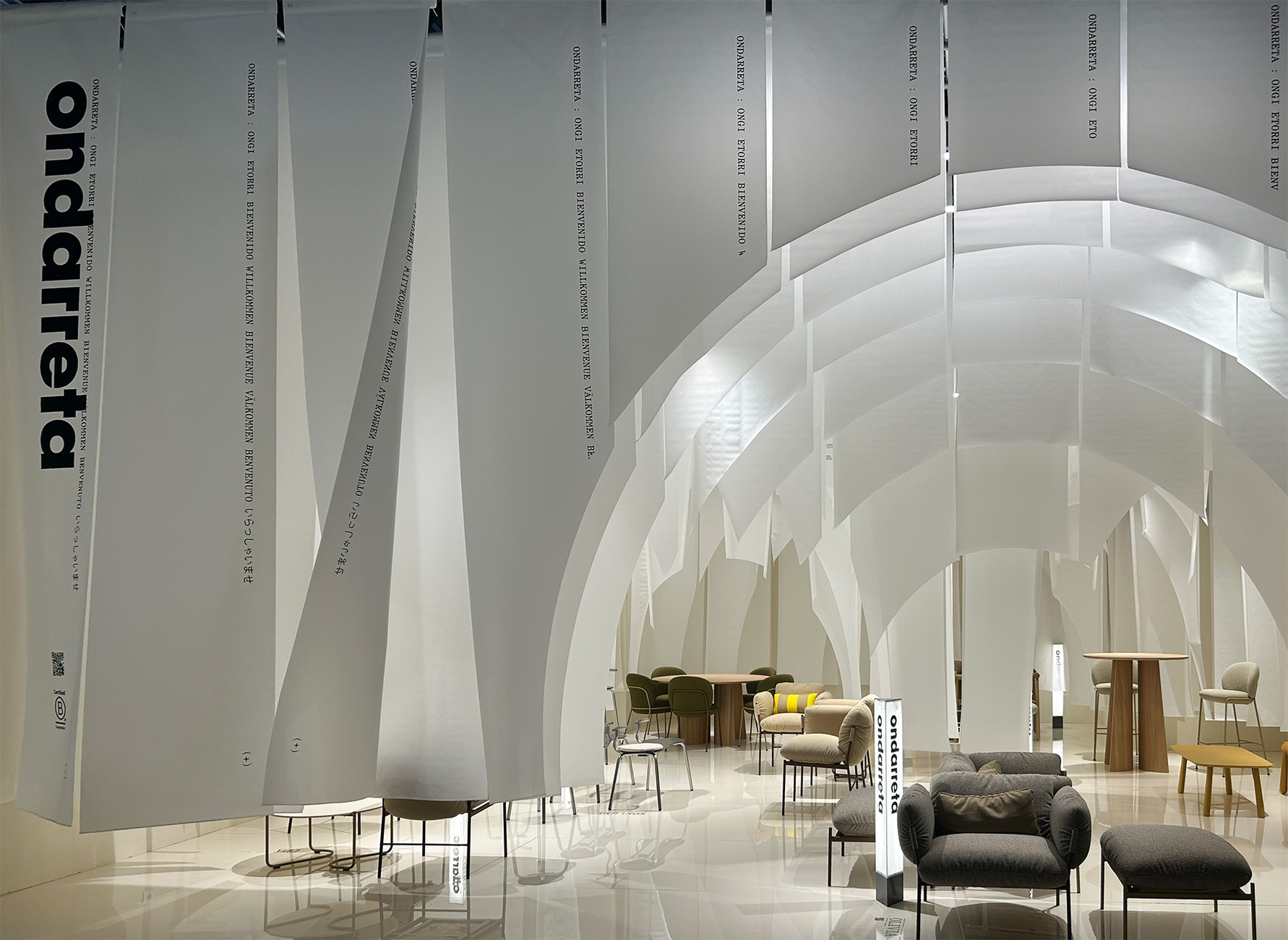
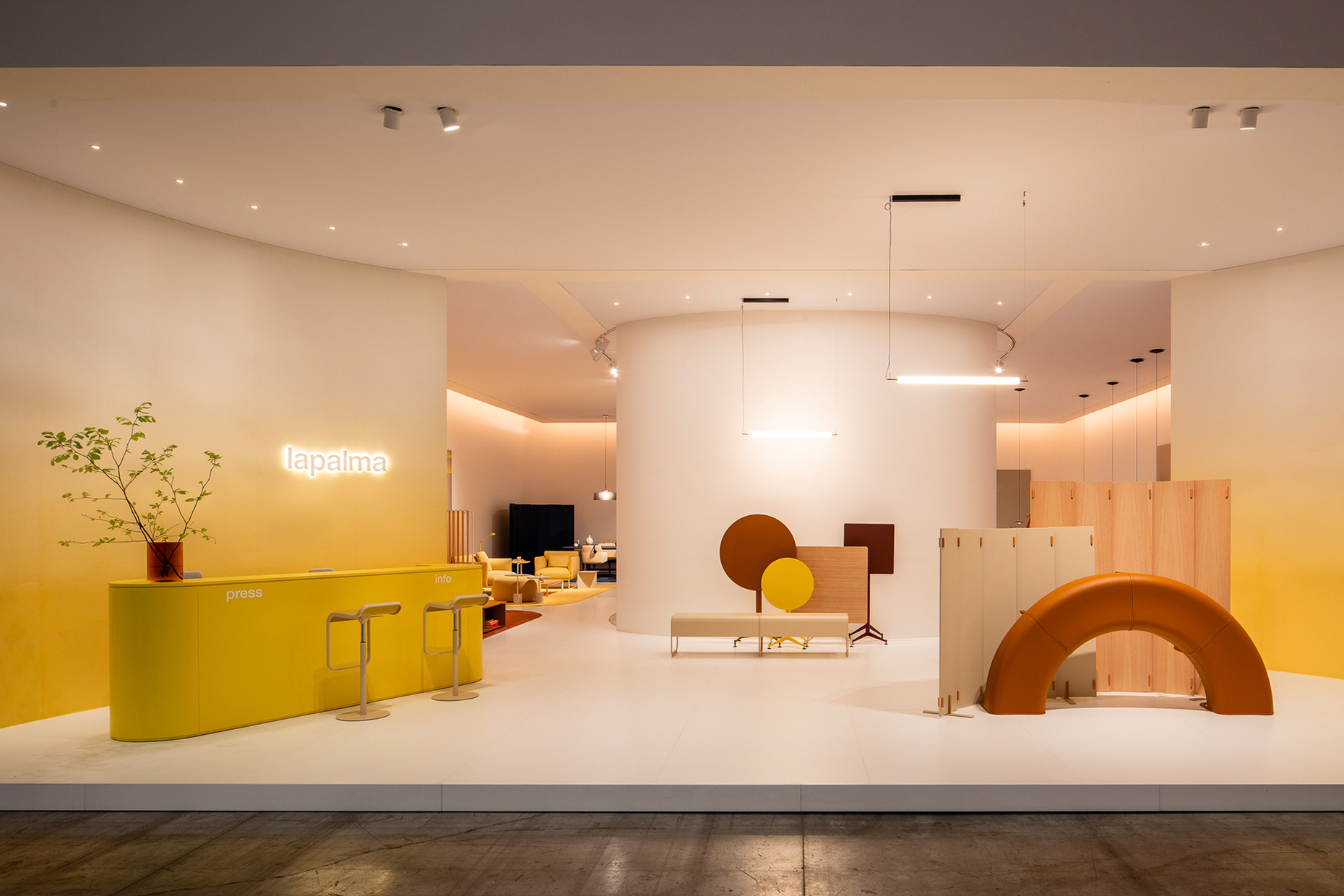
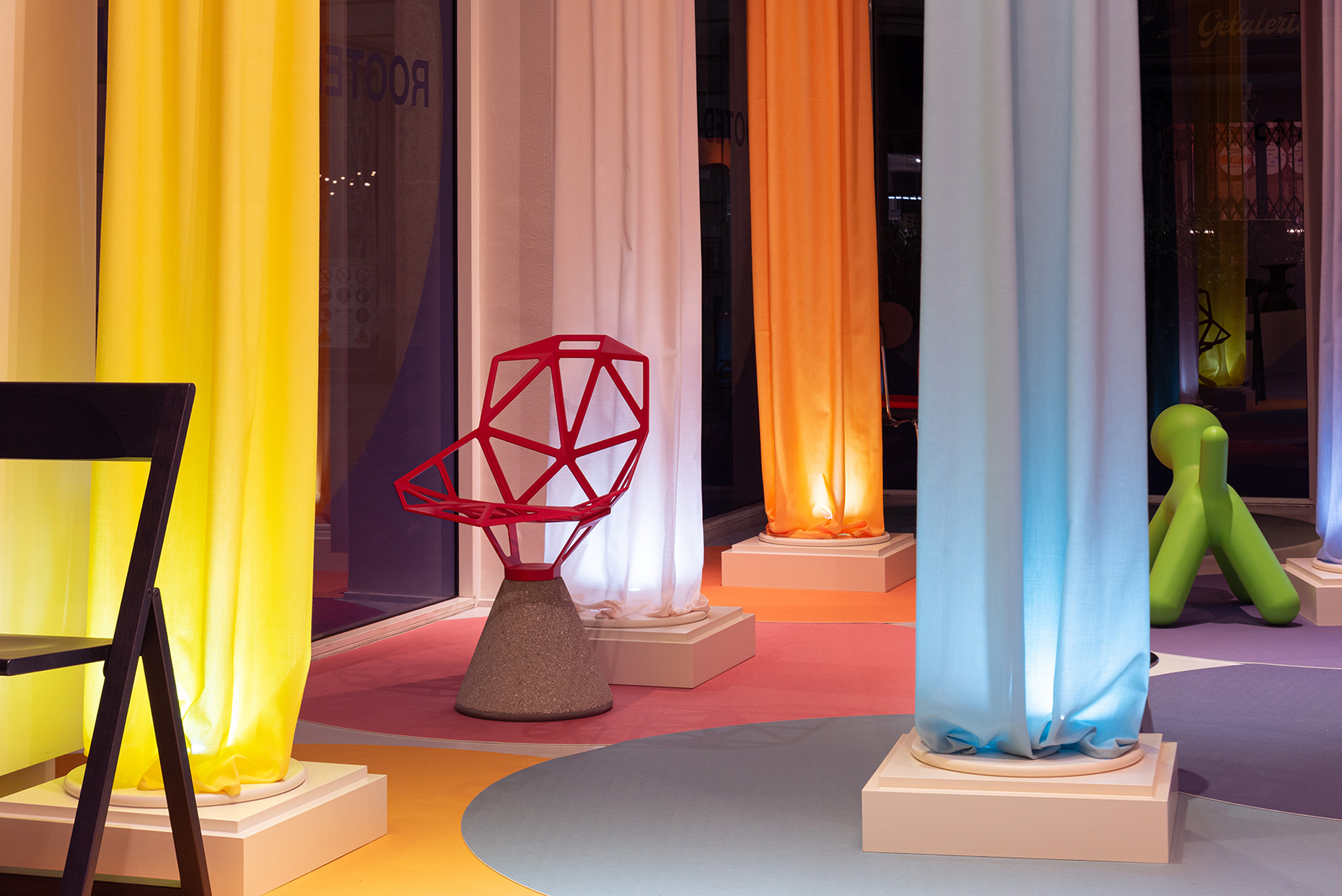
Looking at the stand designs, it was pleasing to see that, alongside the classic living room settings, more manufacturers opted for minimalist structures made of fabric or paper: natural linen, wood and iron formed the basis for the Gandía Blasco stand, designed by Alejandra Gandía-Blasco Lloret. Flexform, Tacchini, Hideo, Campeggi, Ondaretta and Ichendorf also opted for fabric panels to create stand architecture or gently partition off areas. Magis celebrated its 50th anniversary with the exhibition “Rooted in the Future”: the colourful installation consisted of vertical, textile architectural elements, between which both established and new products were presented, including the “Archeo” stool collection by Jaime Hayon and the “Motta” collection by Jasper Morrison.
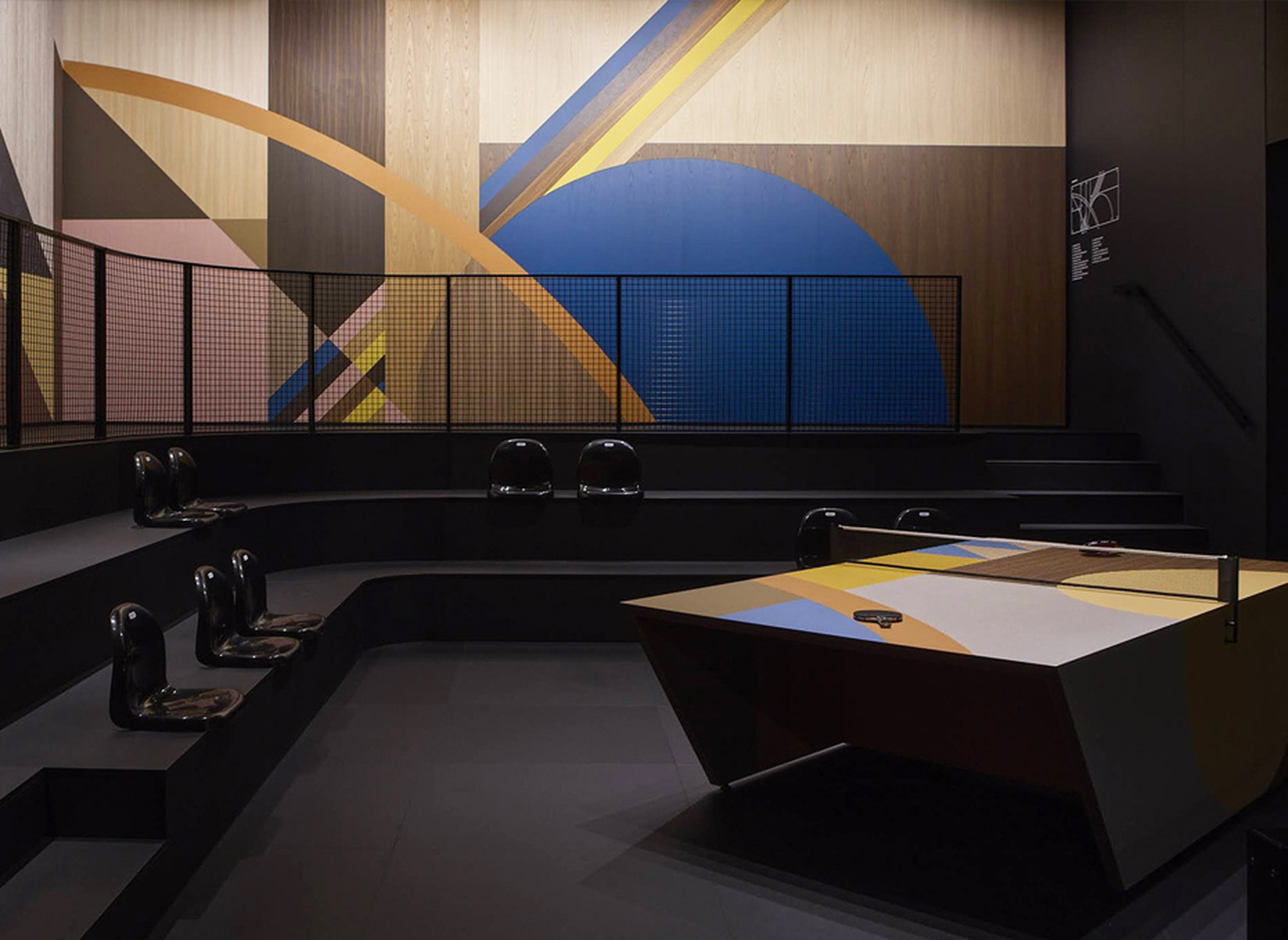
InnoZen used raw scaffolding as a structure, whilst Quadro Design opted for a modular wooden grid as an architectural element, connected by a four-way metal joint that allows for easy reconfiguration of the space. Ravak suspended white, air-filled spheres of various sizes above its stand, demonstrating how an aesthetic effect can be created using simple means. In its “Beyond the lines” concept, Cleaf brought sport and design together – visitors could test their own limits at table tennis on the area designed by Studio Hugo. Studio TrulyTruly developed a large-scale installation for Leolux under the title “Colouring Space”, featuring works by the Amsterdam-based artist Lotje van Lieshout, which continued onto the paper walls. Among other things, visitors to the stand could explore a new wooden “Milo” coffee table by Yabu Pushelberg, whose tabletop, composed of several elements, resembles a tangram shape. Ton stretched yellow struts across his stand, transforming it into an airy pavilion for the stackable wooden “All’essenza” chair by Alexander Gufler. Sancal created “Experimentarium”, a laboratory-style space, and described it as an antidote to cultural uniformity: “We live under the dictatorship of the ‘like’. Fear kills risk. Risk drives progress. Let us reclaim the right to experiment.”
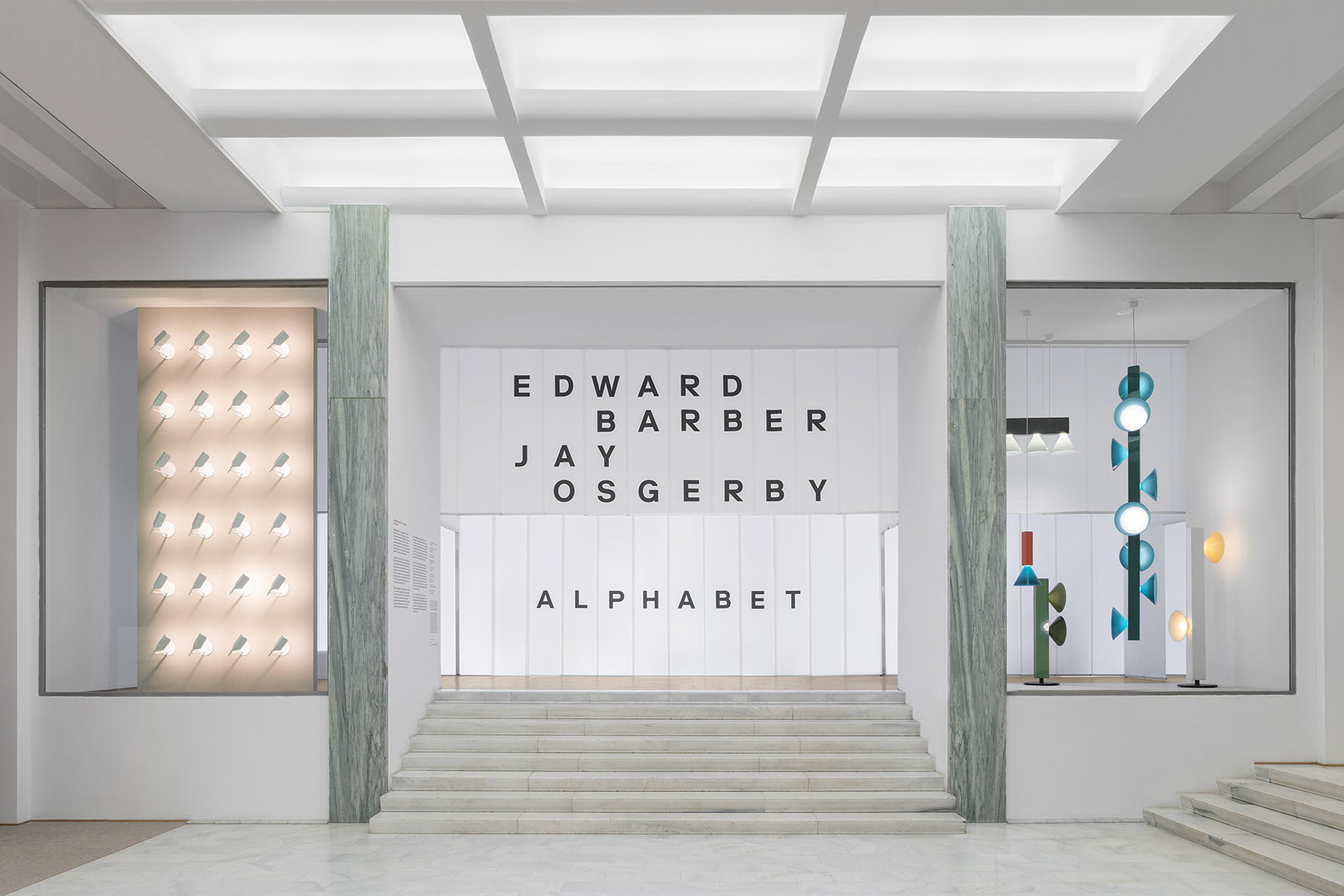
The Triennale is hosting the exhibition “Alphabet” beyond the duration of Milan Design Week; this first retrospective of the work of the London-based design studio Edward Barber and Jay Osgerby is organised by decade. From early experiments to more complex projects, the exhibition pays particular attention to the long-standing relationships with Italian manufacturers and design studios. It highlights how these collaborations have shaped their work and fostered an ongoing dialogue with Italian design culture. The exhibition remains open until 6 September 2026. Until 10 May 2026, visitors can explore the architectural installation “The Eames Houses”, which offers the first comprehensive overview of the residential architecture of Charles and Ray Eames. Based on several years of research, the exhibition examines the enduring relevance of Charles and Ray’s radical thinking on prefabrication, modular construction and human-centred living. Taking their residential projects from the 1940s and 1950s as its starting point, the installation unveils the “Eames Pavilion System”: a new modular architectural system developed by the Eames Office in collaboration with Kettal. Furthermore, Fredericia: A Chronicle of Danish Design, presented exclusively for the week of Milan Design Week, highlighted the development of Danish furniture design from the perspective of the family-run company. The exhibition highlighted the continuity of the company’s ideas and approaches: from collaborations with mid-20th-century pioneers such as Børge Mogensen, Nanna Ditzel and Hans J. Wegner to contemporary designers such as Jasper Morrison, Edward Barber & Jay Osgerby and Cecilie Manz.
Alcova, a platform for experimental design since its inception, opened Villa Pestarini to the public for the first time alongside the exhibition at the Baggio Military Hospital. Designed by Franco Albini in the Italian Rationalist style and completed in 1939, the villa has been preserved largely in its original condition thanks to just two owner families.
The narrow and the broad path
So what conclusions can we draw from the Salone del Mobile and Milan Design Week 2026? Perhaps an excerpt from a design principle that caught my eye at the Nobili stand, under the title “New Normal Archetypes”, sums it up: “Today, the most radical gesture is to seek out the essential. In an age of fleeting trends and visual overload, the philosophy of the ‘New Normal’ emerges from a process of radical reduction. It is a search for the archetypal form: a design so universally ‘right’ that it instantly becomes a classic.” Whilst the Salone del Mobile.Milano recorded fewer exhibitors (2025: 2,103, 2026: 1,900) but a 4.5 per cent increase in visitors compared to 2025, and continues to offer the industry new perspectives with initiatives such as Salone Raritas or Salone Contract, the balance of Milan Design Week between luxury event, tourist trap and space for inspiration is increasingly disrupted. Whilst the event has become more diverse in the disciplines it offers, this has inevitably led to a rise in ‘design tourism’, which seeks fleeting, superficial entertainment. To cater to this group, creative depth has often been nipped in the bud with colourful plastic and copious amounts of confetti. There are already manufacturers who no longer wish to accept this new trend, such as the absurdly high prices for accommodation and exhibition space, and are instead working on developing their own formats – such as the kitchen furniture manufacturer bulthaup. It is to be hoped that the focus on commerce is merely a temporary imbalance in Milan Design Week and that it will regain its equilibrium.
At the Salone del Mobile, the flurry of new products was noticeably less intense than in previous years. Many exhibitors felt, partly due to the increasingly tense global situation, that they could no longer meet the consistently high demand for new products. Instead, formal simplicity, material depth and references to a natural connection to the earth were combined in displays that promised calm and balance. Positive memories and a shift towards the better were key themes in the presentations. The pursuit of sustainability was scarcely conveyed through grand gestures, but on closer inspection, it remains, fortunately, a focus in many processes. In his talk at the Salone Contract Forum, Rem Koolhaas emphasised that design means stepping outside one’s comfort zone to create the right conditions for the industry to continue devising new possibilities. Perhaps it is time to turn our backs on the mainstream path with its inflatable advertising – in favour of design with attitude and relevance. For sharp ideas that ensure the insubstantial distractions quickly run out of steam.